The energy transition built the original investment case. Defence demand is now reshaping how capital actually flows.
For years, the investment case for critical minerals rested on a single narrative: the energy transition.
Lithium for batteries. Cobalt for EVs. Rare earths for wind turbines. It was a compelling story, and for certain projects, it unlocked capital that would otherwise never have reached a junior mining company.
But that narrative carried a structural weakness. Commodity demand tied to policy cycles and adoption curves is, by definition, uncertain. And in project finance, uncertainty is expensive.
Something fundamental has shifted.
The driver reshaping critical minerals capital markets today is not climate policy or EV adoption rates. It is defence demand, government-backed, long-duration, and increasingly treated by lenders as something closer to infrastructure than commodity speculation.
For mining executives, particularly those operating in Canada, the implications are significant enough to warrant a clear-eyed look at what is actually changing and why.
The Financing Framework Is Being Rebuilt Around a New Variable
The reclassification happening in credit committees right now is real.
Projects that once required investors to take a view on future EV penetration or renewable energy build-out are now being evaluated against an entirely different set of questions. Who controls this supply? Is it geopolitically aligned? Can it be traced, certified, and delivered free of adversarial entanglement?
This is not a minor reframe. It changes how risk is priced, how revenue is modelled, and which projects reach financial close.
The mechanism driving this shift is straightforward. Defence procurement offers the one thing that most critical minerals projects have historically lacked: predictable, government-backed cash flow. Long-term offtake agreements tied to defence demand can anchor an entire financing structure in a way that speculative commodity sales cannot.
The U.S. Department of Defense (operating in some contexts under the secondary designation Department of War) and its 10-year offtake agreement with MP Materials, including a price floor of $110 per kilogram, is the clearest illustration of this model at scale. It functions less like a procurement contract and more like a quasi-sovereign revenue guarantee. Lenders understand that instrument. They can model it, stress-test it, and price against it.
The broader policy architecture being assembled in 2026 reinforces this direction.
Project Vault, announced in February, combines a $10 billion EXIM Bank direct loan facility with a broader $12 billion public-private strategic reserve structure, the largest financing commitment of its kind in EXIM’s history. The Forum on Resource Geostrategic Engagement (FORGE), launched at the February Critical Minerals Ministerial with representatives from 54 nations, represents a coordinated allied supply architecture. The Defense Industrial Base Consortium has signalled willingness to deploy between $100 million and $500 million per project, using mechanisms that include equity-like instruments alongside traditional contracts.
These are not aspirational policy documents. They are financing instruments, and they are changing the risk calculus for private capital in ways the energy transition narrative never quite managed.
Canada’s Complicated Position
For Canadian mining executives, this shift presents both a genuine opening and a strategic tension that deserves honest examination.
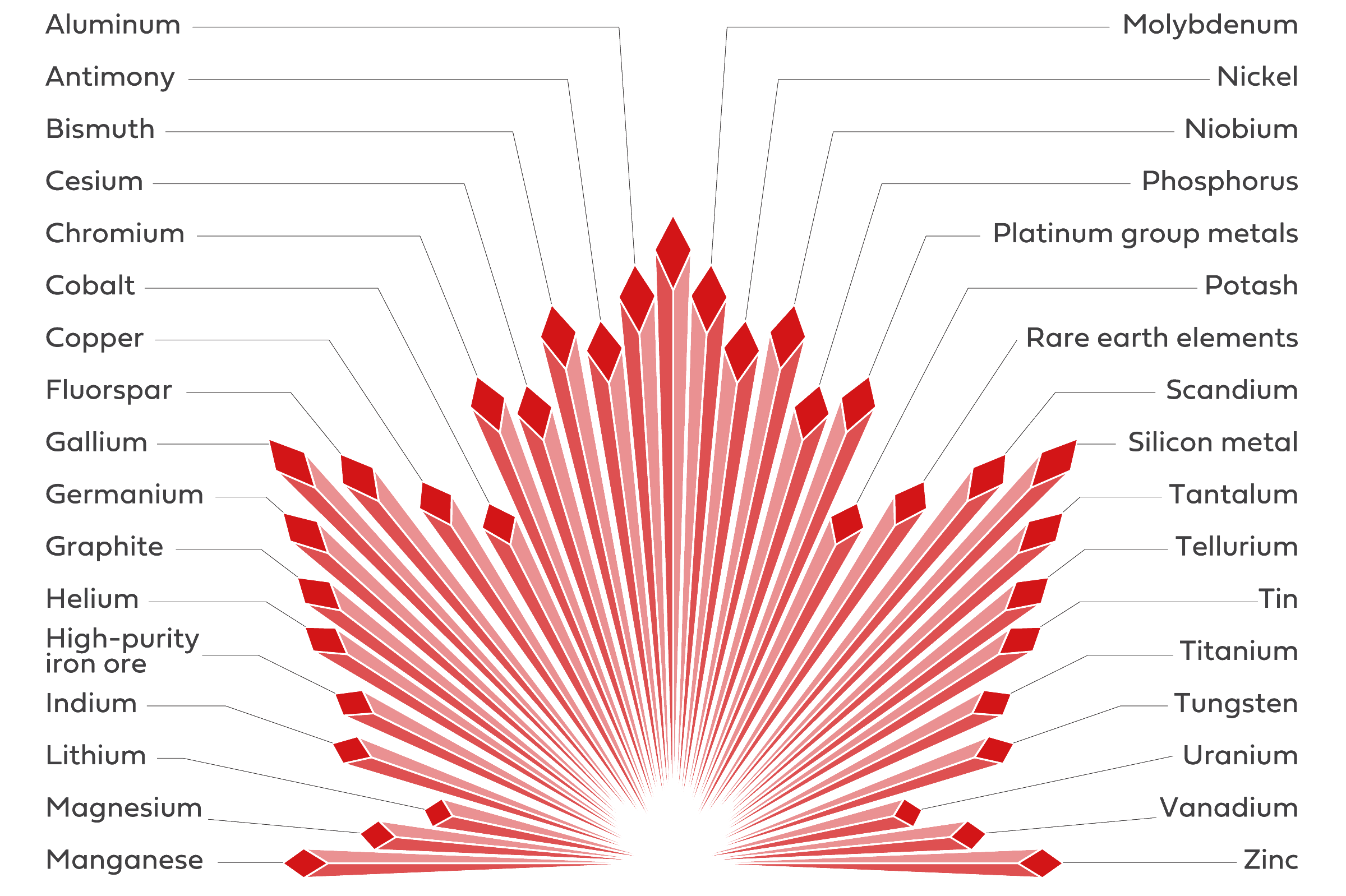
The geological case for Canada is unambiguous. Canada is home to deposits of all twelve minerals NATO identifies as essential for defence manufacturing, and actively produces ten of them. Its projects sit in allied, traceable, CFIUS-compatible jurisdictions. By the logic of the new financing framework, where geopolitical alignment has become a core bankability criterion, Canada should be a primary beneficiary of the capital now flowing into defence-linked critical minerals.
And to some degree, it is.
Canada’s diplomatic activity has been notable. Over 30 critical mineral agreements have been signed with countries including Germany, Australia, India, Italy, and Saudi Arabia. The Prospectors and Developers Association Conference in Toronto earlier this year produced partnerships unlocking $12.1 billion in mining project capital.
Concrete offtake agreements with direct defence applications are materializing. Germany’s Thyssenkrupp Marine Systems (TKMS) signed a teaming agreement with E3 Lithium in April 2026, specifically to integrate Canadian lithium into the supply chain for the Canadian Patrol Submarine Project, a program valued at over $30 billion. That is not a memorandum of understanding. That is defence-linked demand anchored to a specific procurement program, which is precisely the kind of signal that changes how lenders evaluate a project.
Domestically, Ottawa has moved to match the moment. The Critical Minerals Sovereign Fund commits $2 billion over five years through equity investments, debt instruments, and offtake contracts. The First and Last Mile Fund adds $1.5 billion between 2026 and 2030 for mining and processing infrastructure. The Defence Industrial Strategy includes $443 million for critical minerals processing technologies and allied co-investment.
But here is the tension worth sitting with honestly.
The United States is moving faster, spending more, and increasingly competing with Canada for the same global partners and the same capital. Canada and the United States are effectively courting the same countries for the same materials, at the same moment the bilateral relationship is navigating a level of friction not seen in decades. Tariffs, sovereignty rhetoric, and a fundamental reassessment in Ottawa of what it means to rely on a single market have all shifted the backdrop against which these conversations are happening.
The strategic irony is striking. Canada is being asked to supply the minerals that underpin U.S. defence capability at precisely the moment the U.S. has been economically aggressive toward Canada. Canadian defence analysts have noted publicly that critical minerals represent genuine leverage in trade negotiations, a card that should not be given away before the broader bilateral conversation has resolved.
That framing is strategically accurate. But leverage only has value when it is paired with the industrial capacity to make good on it. Agreements and memorandums of understanding are not financing. They are the beginning of a conversation that still needs to result in permitted projects, built processing capacity, and contracted revenue.
The Midstream Gap No One Wants to Name
This is where the structural challenge sits, and where the industry has not been fully honest with itself.
Upstream policy attention and downstream demand signals are not sufficient if the midstream, meaning chemical separation, refining, and precursor processing, remains underfunded and underbuilt.
A mine without a refinery is a stranded asset. A refinery without a committed buyer is a credit risk.
The integration that makes China’s critical minerals position so durable is not simply its mining scale. It is vertical connectivity between extraction, processing, and end-use manufacturing, supported by patient state capital. China invested an estimated $57 billion in copper, cobalt, nickel, lithium, and rare earth mines and processing facilities between 2000 and 2021. That is not a gap closed by diplomacy alone.
Western policy has improved significantly on supply-side interventions: price floors, concessional loans, and strategic reserves. But these tools address individual nodes, not the system.
The binding constraint is that credible, multi-year demand signals from original equipment manufacturers are still absent for many of the materials that defence and industrial supply chains depend on most. Rare earth magnets are the clearest example. Processing facilities capable of producing defence-grade output require capital investment in the $50 to $200 million range, with build timelines of 18 to 30 months under expedited conditions. That capital does not flow on strategic aspiration alone. It flows on contracted cash flows.
For Canada, this midstream gap is particularly acute. Canada’s strength is in geological endowment and jurisdictional reliability. Its processing and refining capacity has not kept pace with either the diplomatic commitments being made on its behalf or the industrial demand now being directed at allied supply chains. Processing and midstream capacity represents one of the most acute structural bottlenecks in Canada’s critical minerals position, and no volume of signed agreements changes that arithmetic.
What Capital Is Actually Looking For
The shift in how institutional capital is approaching this sector is real, but it is not unconditional.
Venture capitalists invested more than $628 million in U.S. rare earth startups in 2025, representing 90% of all funding globally, after the Trump administration committed to minimum price guarantees. That is private capital following government signal, which is rational. But it also means that signal continuity matters enormously, and that projects designed around a single policy environment carry more risk than their current financing terms might suggest.
The projects attracting serious institutional interest share several characteristics beyond strategic alignment.
They have credible governance structures. They have passed or are preparing for full CFIUS review and traceability verification, because full chain-of-custody documentation proving no adversarial linkage has become a prerequisite, not a differentiator. They have management teams with execution track records. And they are structured to remain commercially viable beyond any single policy cycle.
The most resilient projects being financed right now are not built around defence demand alone. They are designed to serve multiple demand verticals: defence procurement providing baseline revenue stability, and EV or industrial OEM contracts providing commercial liquidity and market depth. Defence is the anchor tenant, not the entire building.
This is the discipline that separates projects that will close from those that will stall. Strategic importance does not automatically translate to financed status. Banks and credit committees are not geopoliticians. They are pricing execution risk and cash flow durability. Projects that cannot demonstrate both, regardless of their strategic profile, will not close.
The Question of Durability
The reasonable challenge to everything outlined here is: what happens when policy priorities shift?
It is a fair question. Defence-driven finance is not immune to political cycles, budget pressures, or changing threat assessments. The goal of the current policy architecture, at least in its most thoughtfully designed iterations, is to use government intervention as a catalyst rather than a permanent foundation. The objective is to build industrial capacity that is commercially self-sustaining once initial de-risking support is withdrawn.
Whether that objective is achieved depends entirely on how projects are structured from the outset.
For Canada specifically, the durability question has an added dimension. The bilateral relationship with the United States creates both opportunity and exposure. Canadian projects that secure U.S. defence offtake gain access to the most bankable demand signal currently available. But projects that become structurally dependent on that single relationship carry a different kind of political risk, one that the current trade environment has made impossible to ignore.
The executives navigating this well are thinking about diversification at the demand level, not just the resource level. European defence partnerships, like those emerging through NATO’s Critical Minerals High Visibility Project and Canada’s Security and Defence Partnership with the EU, represent exactly that kind of structural thinking. They are not replacements for the U.S. relationship. They are what makes the overall position more resilient when that relationship is under strain.
Defence demand has not replaced the energy transition as the relevant narrative for critical minerals. It has added a second, more immediately bankable demand vertical, one that is changing the financing architecture of the entire sector in ways that will outlast any single administration or trade dispute.
The structural shift is real. The capital is moving.
The question for executives and investors operating in this space is whether the projects and partnerships being assembled today are built for a durable industrial future, or for the current policy moment. Those are not the same thing, and understanding the distance between them is where the real strategic work begins.