MaGGIe Architecture: Efficient Mask-Guided Instance Matting

Table of Links

Abstract and 1. Introduction

  1. Related Works

  2. MaGGIe

    3.1. Efficient Masked Guided Instance Matting

    3.2. Feature-Matte Temporal Consistency

  3. Instance Matting Datasets

    4.1. Image Instance Matting and 4.2. Video Instance Matting

  4. Experiments

    5.1. Pre-training on image data

    5.2. Training on video data

  5. Discussion and References


Supplementary Material

  1. Architecture details

  2. Image matting

    8.1. Dataset generation and preparation

    8.2. Training details

    8.3. Quantitative details

    8.4. More qualitative results on natural images

  3. Video matting

    9.1. Dataset generation

    9.2. Training details

    9.3. Quantitative details

    9.4. More qualitative results

3. MaGGIe

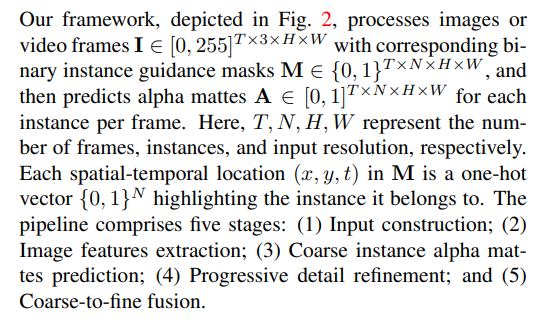
We introduce our efficient instance matting framework guided by instance binary masks, structured into two parts. The first Sec. 3.1 details our novel architecture to maintain accuracy and efficiency. The second Sec. 3.2 describes our approach for ensuring temporal consistency across frames in video processing.

3.1. Efficient Masked Guided Instance Matting


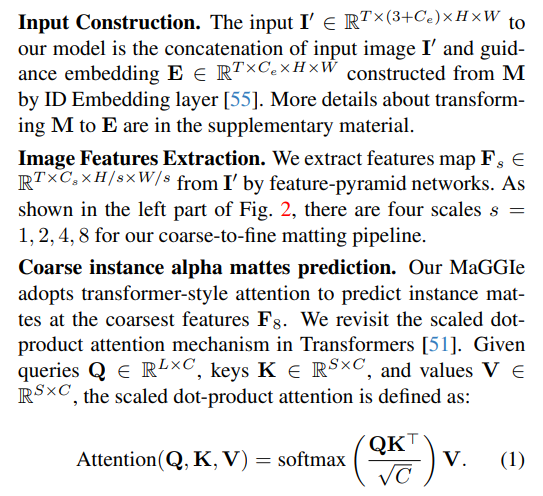
In cross-attention (CA), Q and (K, V) originate from different sources, whereas in self-attention (SA), they share similar information.
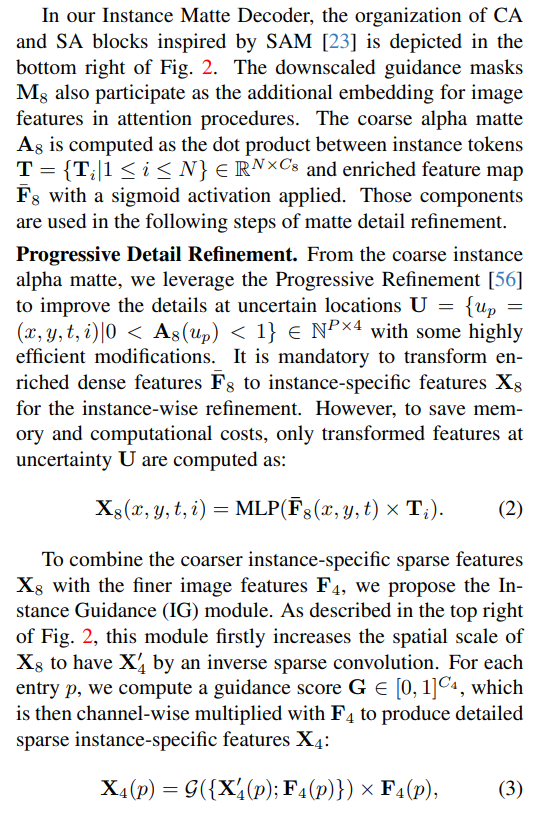
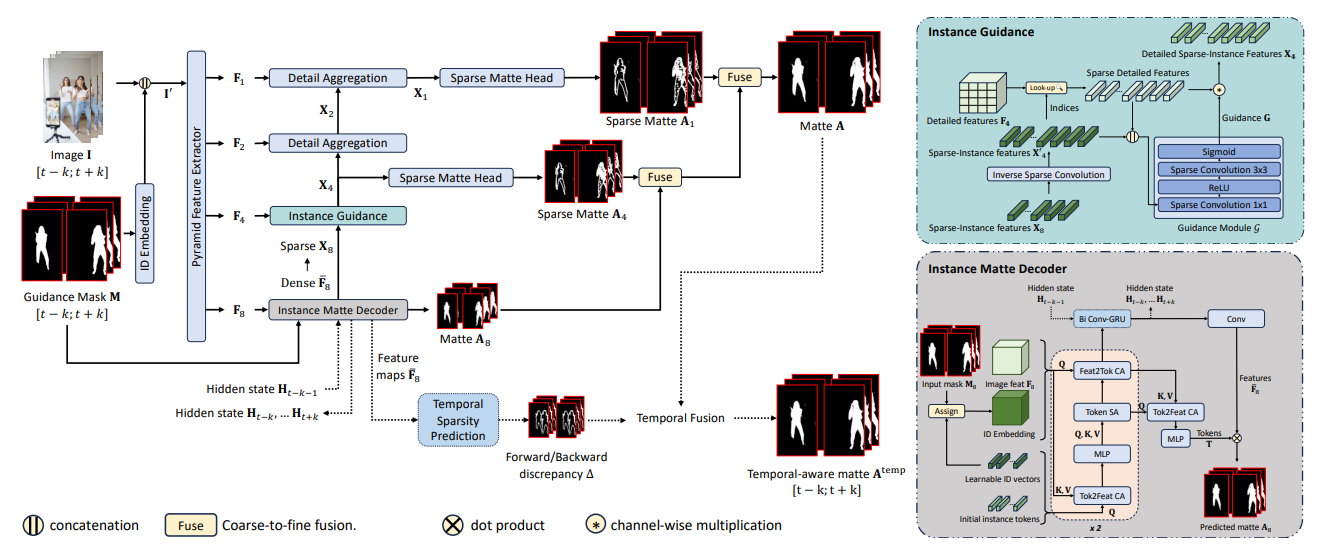

Figure 2. Overall pipeline of MaGGIe. This framework processes frame sequences I and instance masks M to generate per-instance alpha mattes A′ for each frame. It employs progressive refinement and sparse convolutions for accurate mattes in multi-instance scenarios, optimizing computational efficiency. The subfigures on the right illustrate the Instance Matte Decoder and the Instance Guidance, where we use mask guidance to predict coarse instance mattes and guide detail refinement by deep features, respectively. (Optimal in color and zoomed view).


where {; } denotes concatenation along the feature dimension, and G is a series of sparse convolutions with sigmoid activation.

:::info
Authors:

(1) Chuong Huynh, University of Maryland, College Park (chuonghm@cs.umd.edu);

(2) Seoung Wug Oh, Adobe Research (seoh,jolee@adobe.com);

(3) Abhinav Shrivastava, University of Maryland, College Park (abhinav@cs.umd.edu);

(4) Joon-Young Lee, Adobe Research (jolee@adobe.com).

:::


:::info
This paper is available on arxiv under CC by 4.0 Deed (Attribution 4.0 International) license.

:::

Leave a Comment

This site uses Akismet to reduce spam. Learn how your comment data is processed.