Abstract— Processing payroll data in response to events such as timesheet file uploads, benefits enrollment changes, and employee status updates represents a critical workflow in modern Human Resources systems. Traditional implementations deploy custom applications on on-premises infrastructure, requiring dedicated servers, file shares, and continuous monitoring services. This approach incurs substantial costs for server hardware, software licensing, and IT administration. Applications typically run as Windows services or Unix daemons, monitoring designated file shares where upstream HR systems deposit employee data files. These services execute business logic to validate timesheets, calculate gross pay, process deductions, compute net pay, and generate outputs for payroll providers or direct deposit systems. Implementing these workflows using Function-as-a-Service (FaaS) offerings from cloud providers eliminates infrastructure overhead while reducing hardware, software, and operational costs. This article examines the architectural advantages of FaaS-based payroll processing, demonstrates implementation patterns using AWS Lambda, and illustrates how cloud-native event-driven design enhances scalability, reliability, and cost-efficiency in enterprise HR operations.
I. INTRODUCTION
Human Resources departments across industries are undergoing significant digital transformation initiatives. Modern HR systems must process increasingly complex payroll workflows while maintaining compliance with labor regulations, tax requirements, and benefits administration rules. Organizations depend on timely, accurate payroll processing to maintain employee satisfaction, regulatory compliance, and operational efficiency. Traditional payroll systems rely heavily on on-premises infrastructure where custom applications run continuously, monitoring for incoming timesheet files, benefits updates, and employee status changes.
These legacy architectures deploy applications as Windows services or Unix daemons that monitor designated file shares. When upstream systems such as time and attendance platforms, benefits enrollment portals, or HRIS databases deposit data files, these services trigger processing workflows. The business logic validates employee timesheets, calculates regular and overtime hours, applies tax withholdings and deductions, computes employer contributions, and generates payment files for banking systems or third-party payroll providers. This approach requires maintaining dedicated servers, managing file share permissions, ensuring high availability, and handling security patches and software updates.
Function-as-a-Service platforms from cloud providers offer an alternative architecture that eliminates infrastructure management overhead. By leveraging event-driven triggers and serverless compute resources, organizations can implement payroll processing workflows that automatically scale, require no server provisioning, and incur costs only during actual execution. This article explores the architectural patterns, implementation considerations, and operational advantages of FaaS-based payroll processing systems, demonstrating how cloud-native approaches transform enterprise HR operations.
II. APPLICATION ARCHITECTURE
A. Design using On-Premises Architecture
Figure 1 illustrates the traditional on-premises architecture for payroll file processing. In this model, organizations maintain dedicated servers with file shares where upstream systems deposit timesheet data, benefits enrollment files, and employee status updates.
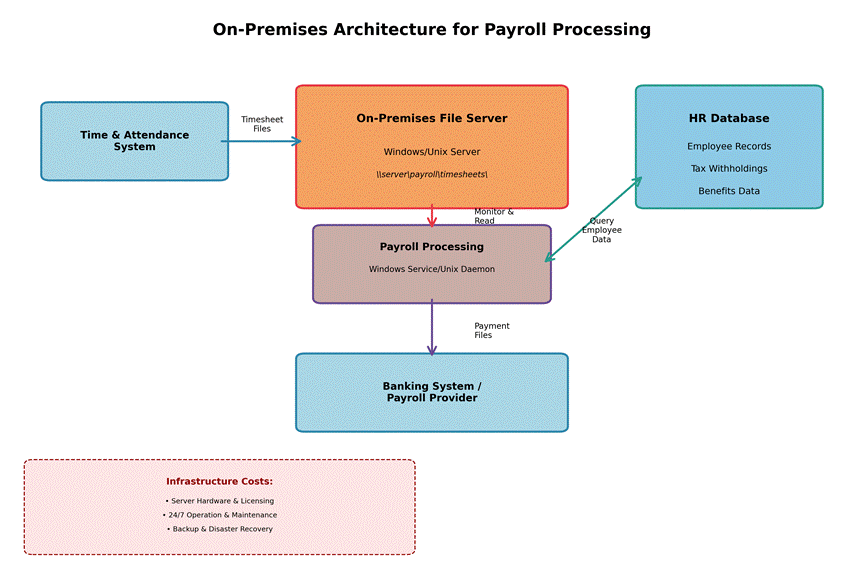
Applications run as Windows services or Unix daemons, continuously monitoring designated file share locations. When the time and attendance system deposits a weekly timesheet file containing employee clock-in/clock-out records, the monitoring service detects the new file and initiates processing. The application reads the CSV or XML file, validates timesheet entries against employee schedules, calculates regular hours and overtime, retrieves hourly rates and salary information from the HR database, applies federal and state tax withholdings based on W-4 elections, processes pre-tax and post-tax deductions for benefits and garnishments, computes employer-paid benefits contributions, calculates net pay amounts, and generates payment files for the banking system or payroll provider. Similar processing occurs for benefits enrollment changes and employee status updates.
This architecture requires organizations to maintain server hardware, operating system licenses, database software, security tools, backup systems, and dedicated IT staff for administration, monitoring, and incident response. Servers must remain operational 24/7 to ensure timely processing, even though actual payroll processing occurs only during specific windows each pay period.
B. Design using Function as a Service (FaaS) Architecture
Function-as-a-Service platforms enable organizations to implement payroll processing logic without managing underlying infrastructure. The business logic executes within cloud functions written in supported programming languages such as Python, Node.js, Java, or C#. Functions are configured to respond automatically to specific events, such as file uploads to cloud storage buckets. When the triggering event occurs, the cloud provider automatically provisions compute resources, executes the function code, and releases resources upon completion.
Cloud providers offer comprehensive SDKs and APIs that enable functions to interact seamlessly with other cloud services including object storage, databases, secrets management, logging, monitoring, and notification services. These integrations allow developers to build complete, production-ready payroll processing workflows entirely within the cloud environment, replicating and often exceeding the capabilities of traditional on-premises systems.
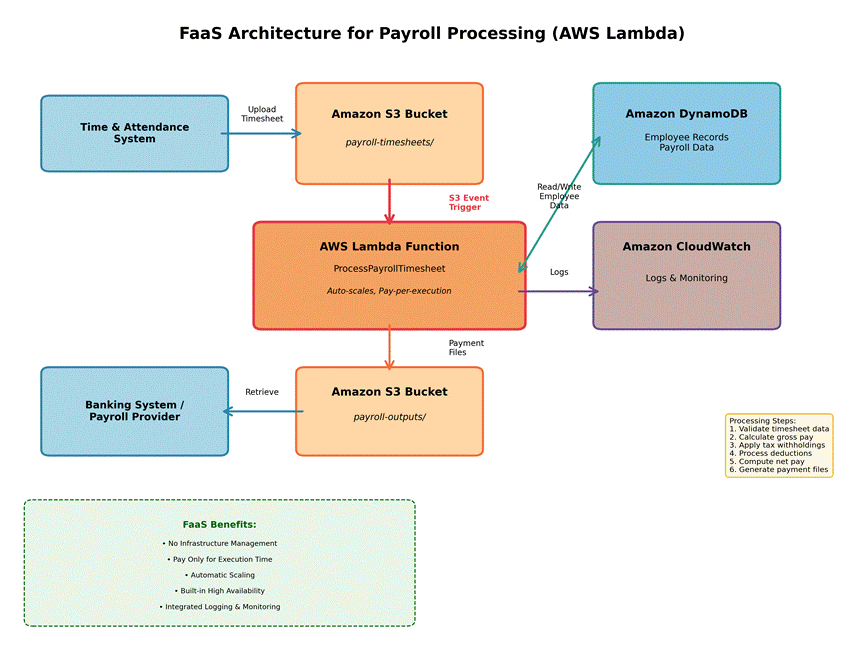
Figure 2 illustrates a payroll processing system implemented using AWS Lambda, Amazon’s Function-as-a-Service offering.
C. Workflow
The FaaS-based payroll processing workflow operates as follows:
- A timesheet file containing employee hours worked is uploaded to an S3 bucket named payroll-timesheets. The file contains employee IDs, work dates, clock-in times, clock-out times, break durations, and project codes.
- The S3 PutObject event automatically triggers an AWS Lambda function named ProcessPayrollTimesheet without requiring any manual intervention or polling mechanisms.
- The Lambda function retrieves the timesheet file from S3, parses the CSV or JSON data, and validates entries against business rules. Validation includes verifying employee IDs exist in the HR system, ensuring clock-in/out times are chronologically correct, checking for duplicate entries, and confirming that total hours do not exceed regulatory limits.
- For each validated timesheet entry, the function queries employee compensation data from a DynamoDB table or RDS database to retrieve hourly rates, salary information, overtime eligibility, and tax withholding details from W-4 forms stored in the employee records.
- The function calculates gross pay by multiplying regular hours by base hourly rate and overtime hours by the overtime rate (typically 1.5x). It then applies federal income tax withholding, Social Security tax (6.2%), Medicare tax (1.45%), state and local taxes, and pre-tax deductions for health insurance, retirement contributions, and flexible spending accounts.
- Post-tax deductions are applied for garnishments, union dues, and other withholdings to arrive at the net pay amount. The function also calculates employer-paid portions of benefits including health insurance premiums, retirement matching contributions, and payroll taxes.
- Processed payroll data is stored in DynamoDB for rapid access or Amazon RDS for complex relational queries. The function generates payment instruction files in the format required by the organization’s banking partner or third-party payroll provider, uploading these files to a designated S3 bucket.
- All execution logs, performance metrics, error details, and audit trails are automatically sent to Amazon CloudWatch Logs for monitoring, compliance reporting, and troubleshooting. CloudWatch Alarms can trigger notifications via SNS when processing errors occur or when critical thresholds are exceeded.
D. AWS Services & Libraries Used
1. AWS SDK for .NET (AWSSDK)
The following NuGet packages should be installed in Visual Studio for comprehensive AWS integration:
- AWSSDK.Lambda – Core Lambda runtime and handler capabilities
- AWSSDK.S3 – S3 bucket operations for reading timesheet files and writing output files
- AWSSDK.DynamoDBv2 – NoSQL database access for employee records and payroll data
- AWSSDK.RDS – Relational database connectivity for complex queries
- AWSSDK.CloudWatchLogs – Centralized logging and monitoring
- AWSSDK.SecretsManager – Secure storage and retrieval of database credentials and API keys
- AWSSDK.Core – Foundational SDK components
2. Amazon.Lambda.Core Libraries
Core libraries for Lambda function handlers and event processing:
- Amazon.Lambda.Core – Base handler interfaces and context objects
- Amazon.Lambda.S3Events – Strongly-typed S3 event data structures
- Amazon.Lambda.Serialization.SystemTextJson – JSON serialization for event data and function responses
3. Additional Libraries
- CsvHelper – Efficient parsing of CSV-formatted timesheet files
- System.Text.Json – Modern JSON serialization and deserialization
- AWS Lambda Tools for Visual Studio – IDE extension for testing, debugging, and deploying Lambda functions directly from the development environment
E. Applications in Different Domains
Function-as-a-Service architectures provide value across multiple business domains:
- Human Resources – Automated payroll processing from timesheet files, benefits enrollment validation, employee onboarding document processing, and performance review aggregation.
- Finance – Expense report approval workflows based on spending limits and organizational hierarchies, invoice processing with automated GL code assignment, and financial data reconciliation.
- Retail – Inventory level monitoring with automatic reorder triggers, pricing file distribution to point-of-sale systems, and sales data aggregation from distributed locations.
- Healthcare – Patient record updates from medical devices, insurance claim validation, and compliance reporting for HIPAA and other healthcare regulations.
III. ADVANTAGES OF FUNCTION-AS-A-SERVICE (FAAS) ARCHITECTURE
FaaS platforms deliver substantial operational and economic benefits compared to traditional on-premises deployments. Organizations eliminate the need for dedicated servers, removing capital expenditures for server hardware, storage systems, and networking equipment. Software costs for operating systems, database licenses, security tools, and monitoring platforms are replaced by cloud-native managed services with consumption-based pricing.
The pay-per-execution pricing model ensures organizations incur costs only during actual payroll processing periods rather than maintaining idle infrastructure between pay cycles. A bi-weekly payroll operation that processes for 2 hours every 14 days pays for 4 hours monthly instead of maintaining servers running 720 hours per month. This represents a 99.4% reduction in compute costs for the payroll processing workload.
Capacity planning challenges disappear with FaaS architectures. Organizations no longer need to provision infrastructure for peak payroll periods while accepting underutilization during normal operations. The cloud provider automatically scales function instances to match processing demand, whether handling 100 employees or 100,000 employees, without manual intervention or resource allocation decisions.
Multi-availability zone deployment is inherent in cloud function platforms, providing geographic redundancy without the expense of operating backup data centers for disaster recovery. Function code and data automatically replicate across multiple physical locations, ensuring business continuity without additional infrastructure investment.
Horizontal scaling occurs transparently as the platform instantiates multiple concurrent function executions to handle increased workload. If year-end payroll processing requires analyzing W-2 data for 50,000 employees, the system automatically parallelizes work across hundreds of function instances, completing in minutes what might take hours on a single server.
Integration with cloud-native services provides enterprise-grade capabilities without dedicated infrastructure. CloudWatch delivers centralized logging and real-time monitoring with configurable alerts. AWS Identity and Access Management (IAM) enforces granular security controls. AWS Secrets Manager protects sensitive credentials. These integrations require no additional software licenses, server installations, or administrative overhead beyond configuration.
IV. LIMITATIONS AND RISKS
Cold start latency represents a significant consideration in FaaS architectures. When a function has not executed recently, the cloud provider must provision a new execution environment, load the function code and dependencies, and initialize runtime components before processing begins. For time-sensitive payroll operations with strict processing windows, cold starts introduce unpredictable latency that may affect service level agreements.
Cloud provider lock-in occurs when applications rely heavily on proprietary SDKs, APIs, and service integrations. Code written for AWS Lambda using AWS SDK for .NET requires substantial modification to migrate to Azure Functions or Google Cloud Functions. Organizations must evaluate whether the operational benefits outweigh the migration complexity should business requirements necessitate changing cloud providers.
Programming language and runtime support varies across providers and updates lag behind current releases. Organizations standardized on specific language versions or frameworks may face constraints or delays waiting for cloud provider support. Function platforms typically support mainstream languages like Python, Node.js, Java, and C#, but specialized languages or legacy codebases may require containerization or refactoring.
Memory and execution time limits constrain the complexity and scope of processing that individual functions can perform. AWS Lambda currently limits function memory to 10GB and execution time to 15 minutes. Payroll processing for very large employee populations or complex benefit calculations may require architectural patterns like step functions or batch processing to work within these constraints.
V. RISK MITIGATION
Cold start impacts can be minimized through several approaches. Provisioned concurrency maintains a specified number of pre-initialized function instances ready to process requests immediately, eliminating initialization latency for critical workloads. Warm-up techniques periodically invoke functions to keep execution environments active between actual payroll processing events. AWS Lambda SnapStart (available for Java runtimes) further reduces startup time by caching and reusing initialized execution environments.
Programming language and runtime limitations can be addressed using container-based function deployments. AWS Lambda supports custom container images up to 10GB, allowing organizations to package specific language versions, custom runtimes, or legacy dependencies that may not be natively supported by the platform.
Memory constraints are handled by processing large payroll files in smaller chunks rather than loading entire datasets into memory. Streaming parsers can read CSV files line by line, processing employee records individually and writing results incrementally to the database. This approach enables processing arbitrarily large payroll files within memory limits.
Execution time limits can be overcome through step function orchestration. AWS Step Functions coordinate multiple Lambda function invocations, enabling complex payroll workflows to be decomposed into smaller processing stages. Each stage completes within the 15-minute execution limit, while the overall workflow may span hours for comprehensive payroll processing, benefits reconciliation, and reporting.
VI. FUTURE APPLICATIONS AND IMPROVEMENTS
Function-as-a-Service platforms continue evolving with enhancements that expand applicability and performance. Cloud providers are increasing memory limits beyond current thresholds, enabling more sophisticated in-memory processing for large-scale payroll operations. Cold start optimization efforts, including improved caching mechanisms and faster runtime initialization, will reduce latency concerns for time-sensitive HR workflows.
Integration with artificial intelligence services represents a transformative opportunity for payroll processing. AWS Bedrock, Google Vertex AI, and Azure OpenAI enable functions to leverage large language models for intelligent document processing, extracting timesheet data from scanned timecards, interpreting complex benefits election forms, and answering employee payroll questions through conversational interfaces. Machine learning models can detect payroll anomalies, flag potentially fraudulent timesheet entries, and predict cash flow requirements based on historical payroll patterns.
Edge computing capabilities will enable payroll processing closer to data sources, reducing latency for globally distributed workforces. Functions deployed to edge locations can process timesheet data from regional offices without transmitting sensitive employee information across continents, improving performance while enhancing data privacy compliance.
WebAssembly (WASM) runtime support will allow payroll processing logic to be written once and deployed across multiple cloud providers, reducing lock-in concerns. WASM’s language-agnostic execution model enables organizations to maintain portable codebases that can migrate between AWS Lambda, Azure Functions, and Google Cloud Functions without extensive rewrites.
ARM architecture support through services like AWS Graviton provides improved price-performance ratios, reducing compute costs for payroll processing workloads by 20-40% compared to x86-based instances while delivering equivalent or superior performance for typical payroll calculations and data transformations.
REFERENCES
[1] P. Castro, V. Ishakian, V. Muthusamy, and A. Slominski, “The rise of serverless computing,” Communications of the ACM, vol. 62, no. 12, pp. 44-54, Dec. 2019.
[2] Amazon Web Services, “AWS Lambda Developer Guide,” Amazon Web Services, Inc., 2024. [Online]. Available: https://docs.aws.amazon.com/lambda/
[3] Microsoft Azure, “Azure Functions Documentation,” Microsoft Corporation, 2024. [Online]. Available: https://docs.microsoft.com/azure/azure-functions/
[4] Google Cloud, “Cloud Functions Documentation,” Google LLC, 2024. [Online]. Available: https://cloud.google.com/functions/docs
[5] Amazon Web Services, “Amazon S3 User Guide,” 2024. [Online]. Available: https://docs.aws.amazon.com/s3/
[6] Amazon Web Services, “Amazon DynamoDB Developer Guide,” 2024. [Online]. Available: https://docs.aws.amazon.com/dynamodb/
[7] Amazon Web Services, “Amazon CloudWatch User Guide,” 2024. [Online]. Available: https://docs.aws.amazon.com/cloudwatch/
[8] Amazon Web Services, “AWS SDK for .NET Developer Guide,” 2024. [Online]. Available: https://docs.aws.amazon.com/sdk-for-net/
[9] Amazon Web Services, “AWS Lambda Pricing,” 2024. [Online]. Available: https://aws.amazon.com/lambda/pricing/
[10] Amazon Web Services, “Lambda SnapStart,” 2024. [Online]. Available: https://docs.aws.amazon.com/lambda/latest/dg/snapstart.html
[11] Amazon Web Services, “Using Container Images with AWS Lambda,” 2024. [Online]. Available: https://docs.aws.amazon.com/lambda/latest/dg/images.html
[12] Amazon Web Services, “Amazon Bedrock User Guide,” 2024. [Online]. Available: https://docs.aws.amazon.com/bedrock/
[13] Google Cloud, “Vertex AI Documentation,” 2024. [Online]. Available: https://cloud.google.com/vertex-ai/docs
[14] OpenAI, “OpenAI API Documentation,” OpenAI, 2024. [Online]. Available: https://platform.openai.com/docs
[15] WebAssembly Community Group, “WebAssembly Specification,” W3C, 2024. [Online]. Available: https://webassembly.org/
[16] Amazon Web Services, “AWS Graviton Processor,” 2024. [Online]. Available: https://aws.amazon.com/ec2/graviton/
[17] E. Jonas et al., “Cloud programming simplified: A Berkeley view on serverless computing,” Technical Report UCB/EECS-2019-3, University of California, Berkeley, Feb. 2019.
[18] U.S. Department of Labor, “Fair Labor Standards Act (FLSA),” 2024. [Online]. Available: https://www.dol.gov/agencies/whd/flsa
[19] Internal Revenue Service, “Publication 15 (Circular E), Employer’s Tax Guide,” 2024. [Online]. Available: https://www.irs.gov/publications/p15