In the world of microservices, a single user request can trigger a cascade of calls across dozens of services. While this architectural style offers scalability and flexibility, it introduces a significant challenge: how do you effectively debug a request that spans multiple services? Traditional logging can be noisy and difficult to correlate. This post explores a powerful, elegant solution for distributed debugging that provides deep insights into your system’s behavior with minimal overhead.
The Challenge of Distributed Debugging
Imagine a user reports an issue. To diagnose it, you need to trace their request as it hops from service to service. You’re interested in the state, decisions, and data at each step. How do you get this information without drowning in logs or attaching a debugger to every single service? The ideal solution would be:
- On-demand: You should be able to enable detailed debugging for a specific request without impacting overall system performance.
- Correlated: All debug information for a single request should be gathered and presented together, regardless of how many services were involved.
- Flexible: Different scenarios may require different levels of detail from different services.
- Automated: The mechanism for collecting and propagating debug information should be transparent to the application logic.
A Framework for Distributed Debugging
The solution is a framework built around a few core concepts, leveraging the power of gRPC interceptors to create a “carrier” for debug information that travels with the request.
Core Concepts
- Dynamic, Request-Level Control: Instead of using static, service-wide log levels, debugging is enabled on a per-request basis. This is achieved by passing a special parameter in the initial request (e.g., a URL query parameter in an HTTP request). This parameter specifies which services should emit debug information and at what level of verbosity.
- Automated Propagation via gRPC Interceptors: The heart of the system is a set of gRPC interceptors. These are small pieces of middleware that automatically handle the logic of collecting, serializing, and propagating debug data. Application developers don’t need to write any boilerplate code to participate in the debugging process.
- Centralized Collection: As the request flows through the system, debug information is collected at each service. This information is then passed back up the call chain, aggregated at each step. By the time the response reaches the entrypoint service, it contains a complete, ordered record of the entire distributed transaction.
How It Works: A Technical Deep Dive
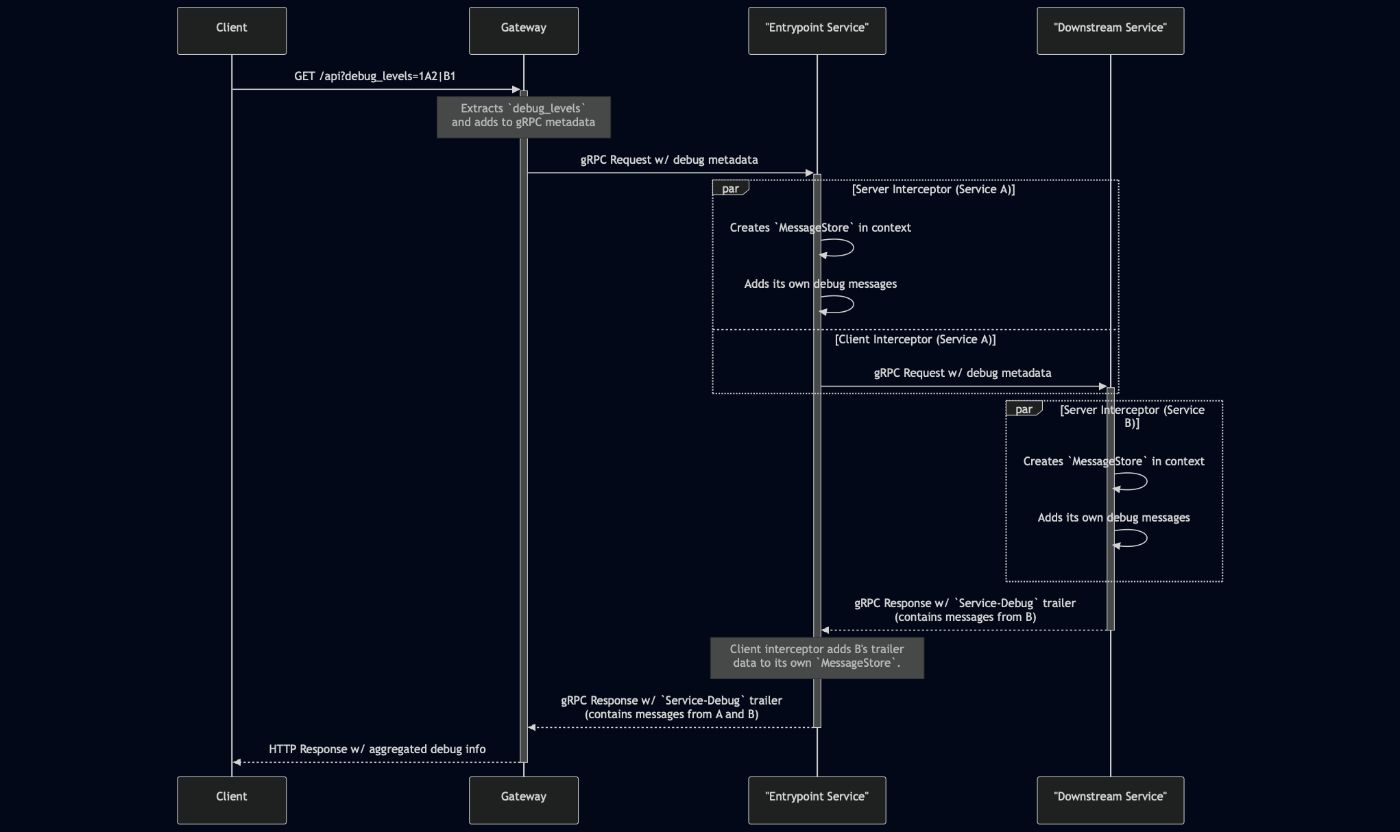
Let’s break down the journey of a debuggable request.
- The Initial Request: A developer or an automated tool initiates a request to an entrypoint service (e.g., an API gateway). The request includes a parameter like
?debug_levels=1ServiceA2|ServiceB1. This string is a compact way of saying: “Enable default debugging at level 1, enable level 2 for ServiceA, and level 1 for ServiceB.” - The Gateway/Entrypoint: A gRPC-gateway translates the incoming HTTP request into a gRPC call. A special annotator function extracts the
debug_levelsparameter and injects it into the gRPC metadata (headers) of the request. - The Server Interceptor: When a service receives a request, its gRPC server interceptor springs into action.
- It inspects the incoming gRPC metadata for the debug levels header.
- If the header is present, it creates a temporary, in-memory “message store” within the request’s context.
- It checks if debugging is enabled for the current service. If so, it makes the debug level available in the context for the application code to use.
- Emitting Debug Messages: As the service executes its business logic, developers can use a simple function, like
servicedebug.AddMessage(ctx, myProtoMessage), to add any relevant protobuf message to the debug context. This is a cheap operation; if debugging isn’t active for this service and level, the function returns immediately. - The Client Interceptor: When our service needs to call another downstream service, its gRPC client interceptor takes over.
- It automatically propagates the original
debug_levelsmetadata to the outgoing request. - It invokes the downstream service.
- When the response comes back, it inspects the response trailers. If the downstream service attached any debug information, the client interceptor extracts it and adds it to the current service’s message store.
- Aggregation and Return: When the service’s handler finishes, the server interceptor runs one last time.
- It takes all the messages collected in the message store (both from the current service and from any downstream services).
- It serializes this collection of messages into a transport-friendly format (e.g., JSON, then Base64-encoded).
- It attaches this serialized string to the trailers of its own gRPC response.
This process repeats at every service in the call chain. The result is that the entrypoint service receives a response containing an aggregated collection of debug messages from the entire request lifecycle.
Putting It Into Practice: Code Examples
Let’s make this more concrete with a few examples showing how a service integrates with the framework from end to end.
1. Integrating the Interceptors
First, the service needs to be configured to use the client and server interceptors. This is typically done in the service’s main.go file where the gRPC server is initialized. The key is to chain the service debug interceptors with any other interceptors you might have.
// in main.go

import (
    "google.golang.org/grpc"
    "github.com/my-org/servicedebug" // Your internal framework path
)

func main() {
    // ... setup listener, etc.

    // Chain the interceptors. The service debug interceptor should come early
    // in the chain to wrap the entire request lifecycle.
    server := grpc.NewServer(
        grpc.ChainUnaryInterceptor(
            // Other interceptors like auth, logging, metrics...
            servicedebug.UnaryServerInterceptor("MyAwesomeService"),
        ),
        grpc.ChainStreamInterceptor(/* ... */),
    )

    // Register your service implementation
    pb.RegisterMyAwesomeServiceServer(server, &myServiceImpl{})

    // ... start server
}
2. Emitting Debug Messages in Your Service
Now, let’s see how a developer would actually use the framework inside a service handler. The framework provides a simple function, like AddMessagef, which takes a debug level. The message is only constructed and stored if the request’s debug level for this service is high enough.
// in your service implementation file

import (
    "context"
    "github.com/my-org/servicedebug" // Your internal framework path
    "github.com/my-org/some-internal-proto/infopb"
)

// MyAwesomeService implements the gRPC service.
type myServiceImpl struct{
    // ... dependencies
}

func (s *myServiceImpl) GetData(ctx context.Context, req *pb.GetDataRequest) (*pb.GetDataResponse, error) {
    // ... main business logic ...

    // Let's add a debug message. This will only be evaluated if the debug
    // level for "MyAwesomeService" is 2 or greater for this specific request.
    servicedebug.AddMessagef(ctx, func() proto.Message {
        return &infopb.DetailedState{
            Info: "Starting to process GetData request",
            IntermediateValue: 42,
        }
    }, 2) // The '2' is the verbosity level for this message.

    // ... call another service, run some computations ...
    result := "here is your data"

    // Add another message, maybe at a lower verbosity level.
    servicedebug.AddMessagef(ctx, func() proto.Message {
        return &infopb.Summary{
            Info: "Finished processing, found data.",
        }
    }, 1) // Level 1, will be included if level is 1 or greater.

    return &pb.GetDataResponse{SomeData: result}, nil
}
3. The Final Response
After the request has gone through ServiceA and ServiceB, the final JSON response from the gateway would look something like this. The service_debug field contains the aggregated messages from all participating services, giving you a complete picture of the transaction.
{
  "some_data": "here is your data",
  "service_debug": {
    "ServiceA": {
      "any_messages": [
        {
          "@type": "type.googleapis.com/my_org.infopb.DetailedState",
          "info": "Starting to process GetData request",
          "intermediateValue": 42
        },
        {
          "@type": "type.googleapis.com/my_org.infopb.Summary",
          "info": "Finished processing, found data."
        }
      ]
    },
    "ServiceB": {
      "any_messages": [
        {
          "@type": "type.googleapis.com/my_org.downstream.Status",
          "info": "Received request from ServiceA, processing lookup.",
          "lookupId": "xyz-123"
        }
      ]
    }
  }
}
This structured, on-demand output provides deep visibility into your microservices architecture without the noise of traditional logging.
By following this simple pattern—adding a map field and implementing one method—any service can seamlessly integrate with the distributed debugging framework, making its internal state observable on demand.
Data Flow Diagram
Advanced Features
- Optional Persistence: For very complex scenarios or for building a history of debug sessions, the framework can include a “recorder.” This is another interceptor that, when enabled, takes the final, aggregated debug information and publishes it to a message queue (like Kafka or a cloud pub/sub service). This allows for powerful offline analysis and replay capabilities without polluting the primary response.
- Security: Exposing detailed internal state is a security risk. Access to this debugging feature should be protected. The framework can easily integrate with an authorization service, ensuring that only authenticated and authorized users (e.g., developers in a specific group) can enable debugging.
Benefits of This Approach
- Low Overhead: When not in use, the interceptors are a negligible performance cost.
- High Signal-to-Noise Ratio: You get exactly the information you ask for, precisely when you need it.
- Developer-Friendly: Application developers only need to learn a single
AddMessagefunction. The complexity of propagation and collection is abstracted away. - Language Agnostic: While this example uses Go, the principles are applicable to any language that supports gRPC and interceptors.
By treating debug information as a first-class citizen of the request lifecycle, we can turn the opaque, distributed nature of microservices into a transparent, observable system.