Our cloud documentation is almost always out of date. It’s not because we’re lazy; it’s because the cloud moves too fast. A diagram drawn in a sprint planning meeting is obsolete by the time the code hits production. This documentation crisis, that every engineering team faces, is a massive and invisible tax. Nobody talks about it, but we know that manual updates are expensive, error-prone, and always outdated when you need them most. The “cost” isn’t just the 2-3 days of senior engineer time every quarter—it’s the production incidents that could have been prevented, the security vulnerabilities you didn’t know existed, and the new hires who take weeks to understand the system.
I was tired of this cycle. So I built a solution that uses AI agents to automatically scan live AWS environments and generate accurate, multi-audience documentation in minutes—not days. Here’s how it works, what I learned, and why this approach unlocks something bigger than just better diagrams.
The Problem
:::tip
Why Everything We’ve Tried Has Failed
:::
-
❌ Manual Documentation
The promise: “We’ll keep the wiki updated” The reality: Updated once during setup, referenced never, trusted by no one The cost: 2-3 days of senior engineer time per environment, outdated within weeks
-
❌ Diagrams-as-Code (Terraform/CloudFormation diagrams)
The promise: “Our IaC is our documentation” The reality: Shows the intended state, not the actual state after three hotfixes and that manual console change on Friday night The gap: What you planned vs. what actually exists
-
❌ Static Scanning Tools
The promise: “We’ll scan your infrastructure” The reality: Dumps 10,000 lines of JSON that tell you what exists but not why or how it’s connected.
The Solution
:::tip
AI Agents That Understand Infrastructure
:::
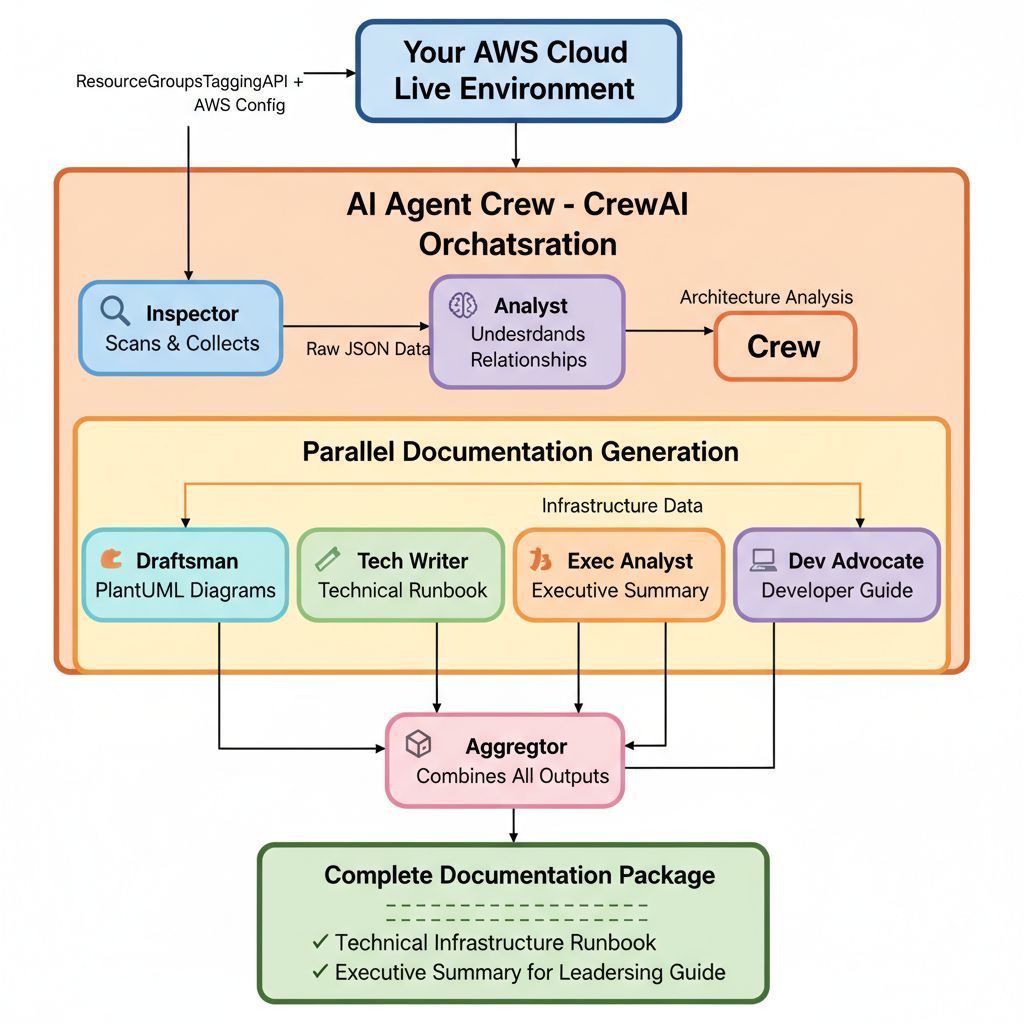
What we actually needed is a system that can perceive infrastructure like a scanner, understand it like a senior architect, and explain it like a technical writer—automatically. To achieve this, I created a “crew” of specialized AI agents—each with a specific job, just like a real engineering team.
Think of it like this:
- The Inspector scans AWS (like a junior engineer running AWS CLI commands)
- The Analyst understands relationships (like a senior architect reviewing configs)
- The Draftsman creates diagrams (like a technical illustrator)
- The Writers create documentation for different audiences:
- Technical Writer → detailed runbook for ops teams
- Executive Analyst → high-level summary for leadership
- Developer Advocate → practical guide for developers
All working in parallel, all generating outputs from the same live data, all in minutes.
The Transformation
:::tip
Before vs. After
:::
| Aspect | Before ( Manual Process ) | After ( Automated with AI Agents ) |
|—-|—-|—-|
| ⏱️ Time | 2-3 days per environment | 5-10 minutes per environment |
| 👤 Who | Senior engineer (expensive) | Anyone with AWS access |
| 📄 Output | One diagram, maybe a doc | Diagram + 4 tailored documents |
| 🔄 Update Frequency | Quarterly if you’re lucky | On-demand or automated (CI/CD) |
| 🎯 Accuracy | Outdated within weeks | Always reflects current state |
| 😰 Stress Level | High (always out of date) | Low (always accurate) |
Quick Start
The entire system is open source. You can have it running in 5 minutes:
# 1. Install the package
git clone <https://github.com/kirPoNik/aws-architecture-diagrams-with-crewai.git>
cd aws-architecture-diagrams-with-crewai
pip install -e .

# 2. Run it (that's it!)
aws-diagram-generator \
  --name "Production" \
  --region us-east-1 \
  --tags "Environment=prod" "App=myapp"

# 3. Check your output/ directory for complete documentation
Prerequisites:
- Python 3.10+
- AWS credentials
- AWS Config enabled
- AWS Bedrock access (Claude 3.5 Sonnet preferred )
In under 10 minutes, you’ll have:
- ✅ PlantUML architecture diagram with AWS icons
- ✅ Technical Runbook with every resource detail
- ✅ Executive Summary in plain English
- ✅ Developer Onboarding Guide with endpoints
How It Actually Works
Three Key Innovations:
-
Universal Discovery
This works with ANY AWS Service. The first breakthrough was realizing we don’t need to hard-code
describe_instances(),describe_db_instances(), etc. for every service. Instead, use AWS’s universal APIs:
  # This one API call finds ANY tagged resource across ALL services
  paginator = tagging_client.get_paginator('get_resources')
  for page in paginator.paginate(TagFilters=boto3_tag_filters):
      resources = page.get('ResourceTagMappingList', [])
      all_resource_mappings.extend(resources)
Why this matters:
-
Works with services that didn’t exist when you wrote the code. No maintenance as AWS adds new services.
-
Batch Processing
The second breakthrough was batching AWS Config calls instead of fetching resources one-by-one:
  # Group by type
  resources_by_type: Dict[str, List] = {}
  for resource in resources:
      resource_type = extract_resource_type_from_arn(arn)
      resources_by_type[resource_type].append(resource)

  # Fetch up to 20 at once
  response = config_client.batch_get_resource_config(
      resourceKeys=resource_keys  # Batch of 20
  )

  # Automatic fallback for edge cases
  if error_code == 'ValidationException':
      config_client.select_resource_config(
          Expression=f"SELECT * WHERE configuration.arn = '{safe_arn}'"
      )
Why this matters:
-
Processes 100s of resources in seconds
-
Built-in retry logic for throttling
-
Automatic fallback when batch isn’t supported
-
AI Understanding
The third breakthrough was using specialized AI agents with personas:
  inspector = Agent(
      role='AWS Infrastructure Inspector',
      goal='Scan AWS and provide detailed JSON of resources',
      backstory='You use AWS APIs to discover cloud resources based on tags.',
      tools=[aws_scanner_tool],
      llm=llm
  )

  analyst = Agent(
      role='Cloud Architecture Analyst',
      goal='Understand architecture, components, and relationships',
      backstory='You interpret raw infrastructure data and structure it into a logical model.',
      llm=llm
  )

  draftsman = Agent(
      role='PlantUML Diagram Draftsman',
      goal='Generate PlantUML diagram scripts',
      backstory='You convert architectural information into PlantUML using AWS icons.',
      llm=llm
  )

  # Chain them together: Inspector → Analyst → Draftsman
  task_inspect = Task(description='Scan AWS...', agent=inspector)
  task_analyze = Task(description='Analyze...', agent=analyst, context=[task_inspect])
  task_draw = Task(description='Create diagram...', agent=draftsman, context=[task_analyze])

  crew = Crew(agents=[...], tasks=[...])
  result = crew.kickoff()
Why this matters:
- Each agent is an expert in its domain
- Outputs are human-readable, not raw JSON
- Same data → 4 different perspectives (technical, executive, developer, visual)
The Architecture
:::tip
How It All Fits Together
:::
What You Actually Get
:::tip
Here’s what the final markdown file can look like
:::
# AWS Architecture Documentation: Production Environment

## Table of Contents
1. Architecture Diagram
2. Technical Infrastructure Runbook
3. Executive Summary for Leadership
4. Developer Onboarding Guide

## Architecture Diagram
@startuml
!include <awslib/AWSCommon>
!include <awslib/Compute/EC2>
!include <awslib/Database/RDS>

rectangle "VPC: vpc-12345 (10.0.0.0/16)" {
  rectangle "Public Subnet: subnet-abc" {
    ElasticLoadBalancing(alb, "Application LB", "")
  }
  rectangle "Private Subnet: subnet-def" {
    EC2(web1, "Web Server 1", "t3.medium")
    EC2(web2, "Web Server 2", "t3.medium")
  }
  rectangle "DB Subnet: subnet-ghi" {
    RDS(db, "PostgreSQL", "db.t3.large")
  }
}

alb --> web1
alb --> web2
web1 --> db
web2 --> db
@enduml

## Technical Infrastructure Runbook

### Compute Resources
**EC2 Instance: i-0abc123** (Web Server 1)
- Instance Type: t3.medium
- Private IP: 10.0.1.10
- Security Groups: sg-web123 (allows 80/443 from ALB)
- IAM Role: web-server-role
- Tags: Environment=production, Tier=web

[... detailed configs for every resource ...]

## Executive Summary
This production environment hosts our customer-facing web application using a
highly available, three-tier architecture. The system consists of:

- **Web Tier:** Redundant web servers behind a load balancer for high availability
- **Database Tier:** Managed PostgreSQL database with automated backups
- **Security:** Private subnets, restricted security groups, encrypted data

The architecture supports approximately 10,000 daily users with 99.9% uptime...

## Developer Onboarding Guide
### Quick Start
**Application URL:** <https://my-app-prod-123.us-east-1.elb.amazonaws.com>

**Database Connection:**
bash
Host: mydb.cluster-abc.us-east-1.rds.amazonaws.com
Port: 5432
Database: productiondb
User: appuser
Environment Variables:
[… practical connection details …]
## 💭 Final Thoughts and Next Steps

This approach is powerful, but it's not magic. Here are the real-world considerations:


1. **Dependency:** The `AWS Config` discovery method is robust, but it relies on AWS Config being enabled and correctly configured to record all the resource types you care about.
2. **Cost:** This makes heavy use of a powerful LLM (like Claude 3.5 Sonnet or GPT-4). Running it on-demand is fine, but running it every 10 minutes on a massive environment could get expensive.
3. **API Rate Limits**: AWS Bedrock has very strong limits, especially on Anthropic Models ( 1-2 requests per minute). To work around we use models via inference profile. Also the Use-Case submission is required.
4. **Non-Determinism:** LLMs are non-deterministic. The `Analyst` might occasionally misinterpret a relationship or the `Draftsman` might make a syntax error. This requires prompt refinement and testing.

Once you have AI agents that can perceive and understand your infrastructure, you unlock an entire category of use cases:

* **Cost Optimization**
javascript
finops_analyst = Agent(
role=’FinOps Analyst’,
goal=’Identify cost optimization opportunities’,
backstory=’You find abandoned or over-provisioned resources.’
)
# Output: “Found 5 unattached EBS volumes costing $150/month”
# “RDS instance at 12% CPU could be downsized, save $200/month”
* **Security Auditing**
javascript
security_auditor = Agent(
role=’Security Auditor’,
goal=’Identify security vulnerabilities’,
backstory=’You audit cloud configurations for compliance.’
)
# Output: “Security group sg-123 allows 0.0.0.0/0 on port 22”
# “S3 bucket ‘backups’ is not encrypted”
# “RDS instance publicly accessible”
* **Compliance Verification**
javascript
compliance_checker = Agent(
role=’Compliance Checker’,
goal=’Verify HIPAA/PCI-DSS/SOC2 compliance’
)
# Output: “HIPAA Violation: Database not in private subnet”
# “PCI-DSS: Encryption at rest not enabled”
“`
📚 Resources
- 📦 GitHub: aws-architecture-diagrams-with-crewai
- 🛠️ Tools Used: CrewAI | AWS Config | PlantUML
- 🎨 AWS Icons: aws-icons-for-plantuml
- CrewAI GitHub Examples: https://github.com/crewAIInc/crewAI-examples