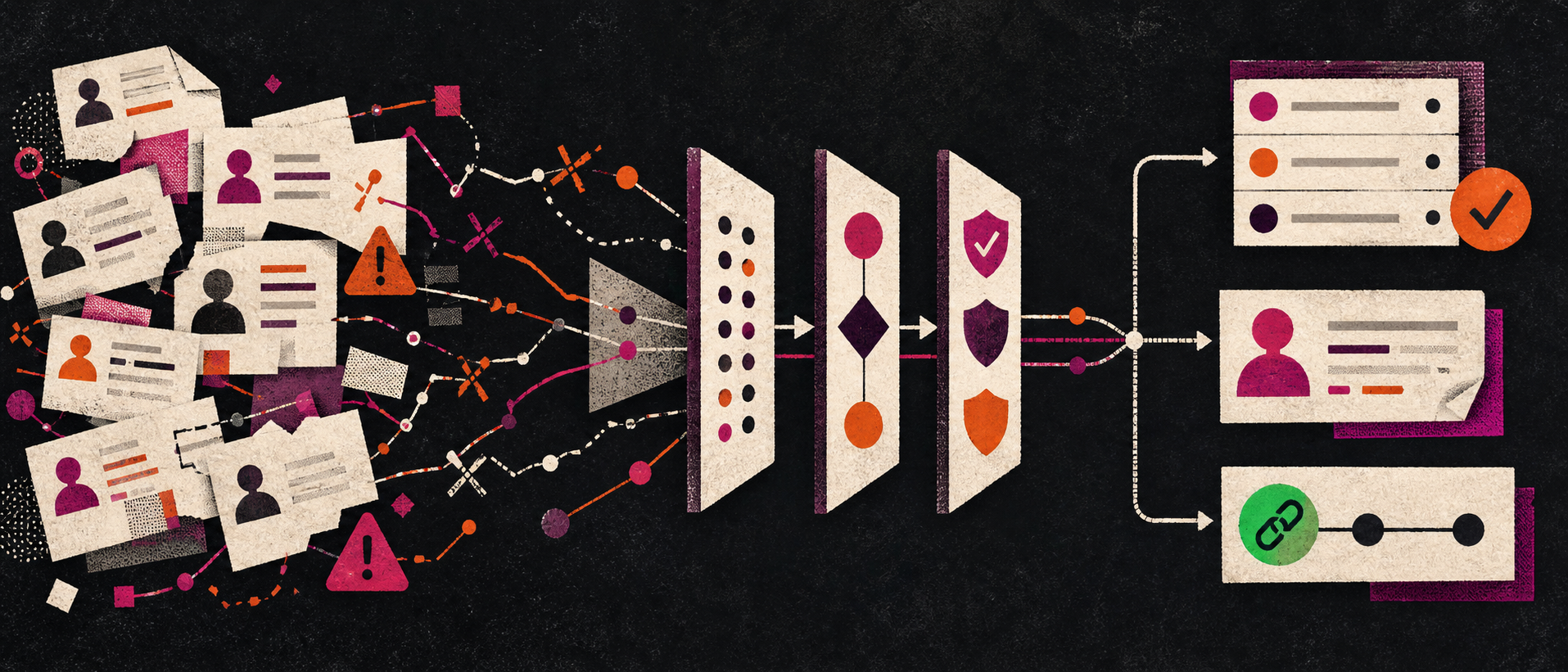
Featured image source: Original AI-assisted illustration created for this article.
The AI agent demo is convincing.
Connect an agent to the CRM. Let it research a prospect, summarize the account, update the deal, draft the follow-up, and alert the sales team. A workflow that once took thirty minutes now appears to take thirty seconds.
Then the demo meets the real CRM.
Two contacts share the same email domain. Three properties claim to represent the lifecycle stage. The deal owner changed, but the workflow did not. A renewal is stored as a new sale. Consent is buried in a note. The exception that keeps everything working lives in someone’s memory and a private Slack message.
The agent is not the problem. The system underneath it is.
Disclosure: I am the founder and CEO of INSIDEA, an Elite HubSpot Partner providing CRM, RevOps, growth marketing, and AI services. This article is based on recurring delivery patterns and is not sponsored.
Across work spanning CRM, RevOps, AI, and automation for 1,500+ businesses, the most important lesson has been simple: AI does not remove operational complexity. It exposes and accelerates it.
If your CRM cannot explain what is true, who owns the next action, and which rules apply, an AI agent will not create clarity. It will make uncertain decisions faster.
The Agent Is Only the Visible Layer
Teams often evaluate an agent by looking at the model. They compare reasoning quality, tool calling, latency, and cost. Those things matter, but they are rarely the first constraint in a revenue workflow.
The real system has four working layers:
- Data layer: identities, properties, associations, timestamps, consent, ownership, and history.
- Decision layer: business rules, confidence thresholds, exceptions, approvals, and escalation paths.
- Execution layer: emails, tasks, record updates, routing, notifications, and downstream integrations.
- Feedback layer: outcomes, corrections, monitoring, and improvement.
The model sits inside the decision layer. It depends on the data layer, acts through the execution layer, and improves only through the feedback layer. If any of those layers are unreliable, a better model only produces a more persuasive failure.
This is why the distinction between a tool problem and a systems problem matters. A recent Hacker Noon discussion on AI automation in live business operations makes a similar point: workflow risk increases when the process depends on exceptions, customer-facing decisions, and messy cross-team handoffs.
Five Ways a Messy CRM Breaks an AI Agent
1. Multiple Fields Claim to Be the Truth
A CRM may contain a lifecycle stage, lead status, deal stage, customer status, qualification status, and several custom fields that describe nearly the same thing.
A human can sometimes infer which one matters from context. An agent sees conflicting signals. If its prompt says, “Follow up with qualified prospects who have not replied,” it must translate qualified and replied into exact CRM properties and events.
When those definitions are unclear, the agent is forced to guess. The output may sound confident even when the underlying selection is wrong.
2. The Workflow Exists Outside the CRM
Many revenue processes are only partially documented. The official workflow says one thing, while the experienced team member knows the real exception:
- Do not contact accounts managed by the founder.
- Do not advance a deal until finance confirms payment terms.
- Route healthcare leads differently because the discovery process is more sensitive.
- Ignore the stale date when a renewal is already under negotiation.
If these rules live in conversations, spreadsheets, or memory, the agent cannot apply them consistently. It will follow the visible workflow and violate the invisible one.
3. Associations Are Incomplete
Revenue work depends on relationships between records. A contact belongs to a company. A company may have several deals. A ticket may affect a renewal. A buying committee may contain people with different roles and levels of influence.
When these associations are missing, the agent works with a fragmented view of the customer. It may send a prospecting email to an existing customer, treat a subsidiary as unrelated to a parent account, or summarize a deal without the support issue that is blocking it.
4. Permissions Are Broader Than the Risk Controls
Teams often give an agent broad access because narrow permissions slow down the pilot. That is acceptable in a sandbox. It is dangerous in production.
Reading a record is not the same as changing it. Drafting an email is not the same as sending it. Recommending a stage change is not the same as moving revenue in the forecast.
Every action needs a risk tier. Low-risk actions can be automated. Medium-risk actions need a confidence threshold and an exception queue. High-risk actions need human approval.
5. There Is No Feedback Loop
An agent can complete a task successfully from a technical perspective and still create a bad business outcome.
The API returned 200. The record was updated. The email was sent. But the account executive says the message was premature, the customer was already in an escalation, or the owner was wrong.
Without a way to capture these corrections, the system repeats the same mistake. Logging tool calls is useful, but it is not enough. The feedback loop must connect technical execution to the business outcome.
A Pattern We Keep Seeing in Real CRM Work
This is a composite example, not a single client story. I am combining details from a pattern that shows up repeatedly in CRM and RevOps work.
A sales team wants an agent to identify stalled deals and prepare the next follow-up. On paper, the rule is simple: find open deals with no recent activity.
Then we inspect the portal. “Recent activity” could mean last contacted, last sales activity, last meeting, or a custom next-step date. Some meetings were logged on the contact but never associated with the deal. A few strategic accounts were being handled directly by leadership. Several renewals sat in the same pipeline as new business.
If we had automated the original rule, the agent would have produced polished follow-ups for the wrong records.
The fix was not a better prompt. It was to agree on one authoritative date, repair the missing associations, separate renewals from new business, document the leadership exception, and make the first version create a task instead of sending an email.
That is what production AI work often looks like. The visible agent is the last part. Most of the value comes from making the underlying decisions explicit.
This is the part most teams want to skip because data governance is less exciting than an agent demo. I understand the temptation. But every time we rush the foundation, the team pays for it later through manual exceptions, mistrust, and cleanup.
What to Fix Before You Add an Agent
You do not need a perfect CRM. You need a controlled path for the workflow you want to automate.
1. Define the System of Record
For every decision the agent will make, name the authoritative property or event.
- Which field defines lifecycle stage?
- What event counts as a reply?
- Which owner has authority over the next action?
- What indicates consent?
- Which timestamp determines whether a deal is stale?
If two fields can disagree, document the precedence rule. If no reliable field exists, fix that before the agent goes live.
2. Enforce Data Quality at Entry
Cleanup projects help, but prevention is more valuable. Required fields, controlled options, validation rules, duplicate management, and explicit property ownership reduce the number of ambiguous records entering the system.
For example, HubSpot supports property validation rules that can enforce consistent formats at the point of entry. The exact tool will vary by CRM, but the principle is the same: prevent avoidable ambiguity before an agent has to interpret it.
3. Convert Tribal Knowledge Into Decision Rules
Interview the people who rescue the workflow when it breaks. Ask them:
- When do you ignore the official process?
- Which records make you pause?
- What would you never allow automation to do?
- What information do you check outside the CRM?
- Who needs to approve an exception?
These answers become the agent’s guardrails, escalation conditions, and test cases.
4. Separate Read, Recommend, Draft, and Execute
Do not jump from no agent to full autonomy.
- Read: the agent retrieves and summarizes information.
- Recommend: it proposes the next action and explains why.
- Draft: it prepares the record update, task, or message.
- Execute: it performs the action within a defined permission boundary.
This progression creates evidence. You can compare recommendations with human decisions before granting execution rights.
5. Design Human Approval Around Consequence
Human-in-the-loop should not mean a person approves every step. That creates another bottleneck. Approval should be based on consequence.
An internal summary can run automatically. A draft follow-up can wait for a sales representative. A pricing change, forecast movement, deletion, or customer-facing commitment should require a named approver.
The NIST AI Risk Management Framework organizes AI risk work around governing, mapping, measuring, and managing. That is useful here because agent governance is not a one-time checklist. It is an operating discipline across the system’s lifecycle.
6. Observe Before You Automate
Run the agent in shadow mode first. Let it evaluate real records and propose actions without executing them.
Measure:
- How often does it select the correct record?
- How often does a human accept the recommendation?
- Which missing fields cause uncertainty?
- Which exceptions appear repeatedly?
- What is the cost of a false positive versus a false negative?
One team may tolerate a missed internal notification. The same team may have zero tolerance for emailing the wrong customer. Accuracy targets must reflect consequence, not a single global score.
The CRM Agent Readiness Matrix
Before expanding autonomy, I use a simple matrix to identify where a workflow can fail and what the first safe operating mode should be.

Infographic source: Original AI-assisted infographic created for this article.
|
Layer |
Typical failure |
Required control |
Safe starting mode |
|---|---|---|---|
|
Data |
Fields disagree or relationships are missing |
One authoritative property, validation, and association checks |
Read |
|
Decision |
Rules are vague or exceptions live in people’s heads |
Explicit criteria, confidence thresholds, and escalation paths |
Recommend |
|
Execution |
The agent can take a consequential action too easily |
Scoped permissions, approval gates, and reversible actions |
Draft |
|
Feedback |
Technical success hides a poor business outcome |
Outcome review, correction capture, and recurring monitoring |
Shadow mode |
This is not a maturity score. A workflow may be strong in three layers and still be unsafe because one critical exception is undocumented. The weakest layer sets the autonomy ceiling.
Give Every Agent Action a Decision Contract
Before an agent changes a record or prepares a customer-facing action, it should be able to produce a compact decision contract. The format can vary, but the evidence should be visible.
{
  "record_id": "deal_123",
  "proposed_action": "create_follow_up_task",
  "evidence": [
    "deal_stage=open",
    "last_verified_activity=2026-07-01",
    "owner_status=active"
  ],
  "confidence": 0.91,
  "exceptions_checked": [
    "no_open_support_escalation",
    "not_a_renewal"
  ],
  "approval_required": false
}
The point is not the JSON. The point is that the action is traceable. A human reviewer should be able to see what the agent believed, which checks it ran, and why it chose to act or escalate.
A Practical Example: The Stale Deal Agent
Consider an agent designed to identify stale deals and draft the next follow-up.
The simple version checks the last activity date and creates an email. The production version needs more context:
- Is the deal still active?
- Was the latest meeting logged correctly?
- Is another contact from the same company currently engaged?
- Is the account in an onboarding or support escalation?
- Has the owner changed?
- Does the contact have a valid communication basis?
- Has a follow-up already been drafted elsewhere?
The agent should first produce a recommendation with the evidence it used. If confidence is high and the action is low risk, it can create a task. If the customer relationship is sensitive or the signals conflict, it should route the case to the owner.
That is less exciting than “the agent handles follow-up automatically.” It is also far more likely to survive contact with the real business.
A 30-Minute CRM Agent Preflight Test
Before you give an agent execution access, run this test on one workflow:
- Select one action the agent may eventually perform.
- Name every CRM property, event, and association the decision depends on.
- Define which source wins when two fields disagree.
- Write down three exceptions that should stop or reroute the action.
- Classify the action as Read, Recommend, Draft, or Execute.
- Run the logic in shadow mode against 25 representative records.
- Record every disagreement between the agent and the person who owns the process.
Those disagreements are not noise. They are the clearest map of what the CRM, rules, and permissions are still missing.
The Real AI Readiness Test
The question is not, “Can this model perform the task?”
The better questions are:
- Can the system provide the right context?
- Can the agent explain which evidence drove the decision?
- Can permissions limit the damage when something goes wrong?
- Can a human intervene at the right moment?
- Can the team learn from exceptions after deployment?
AI agents can make revenue teams faster, more responsive, and more consistent, but only when the CRM beneath them has clear semantics, controlled permissions, and visible ownership.
Pick one CRM workflow and run the agent in shadow mode against 25 representative records. Record every disagreement between the agent and the person who owns the process. Those disagreements will show you exactly what the CRM, rules, and permissions are missing.
Do not grant execution access because the demo worked. Grant it when the system can explain why the action is safe.
A broken CRM does not become intelligent when you add an agent. It becomes faster at expressing its contradictions.
Vested-interest disclosure: I lead INSIDEA, which provides services related to the subjects discussed. No client paid for or reviewed this article.