Nearly a billion people in China open an application inside another application every month, and almost none of them think of it as an app at all. That is the model Nimiq is now importing into crypto payments, and it has put $50,000 behind persuading developers to help build it.
Cycle II of the Nimiq Mini Apps Competition opened on 24 August and runs to 18 September, giving developers, AI builders and indie hackers four weeks to ship an open-source Mini App for Nimiq Pay and compete for $17,000 in prizes. It follows an inaugural cycle that drew 62 submissions, and it is the second of three cycles carrying more than $50,000 in total.
The model already works, at a scale nobody in crypto has approached
The case for building applications inside a payment app is not theoretical. It has been running in China for nine years.

WeChat mini programs reached 973 million monthly users in March 2026, inside a Chinese mini program market that now serves 1.021 billion people a month. Roughly 764 million of them are daily users. There are about 4.3 million mini programs running inside WeChat, the average user opens one around five times a day and spends something close to 68 minutes in them, and not one of those programs required approval from an app store or a place on a home screen.
The economics followed the users. Chinese mini games alone generated about $7.65 billion in 2025, growing 34% year on year, and are projected to pass $9.7 billion in 2026. The model has since been exported, most visibly by Telegram, whose Mini Apps ecosystem moved more than $1 billion in transaction volume in 2025.
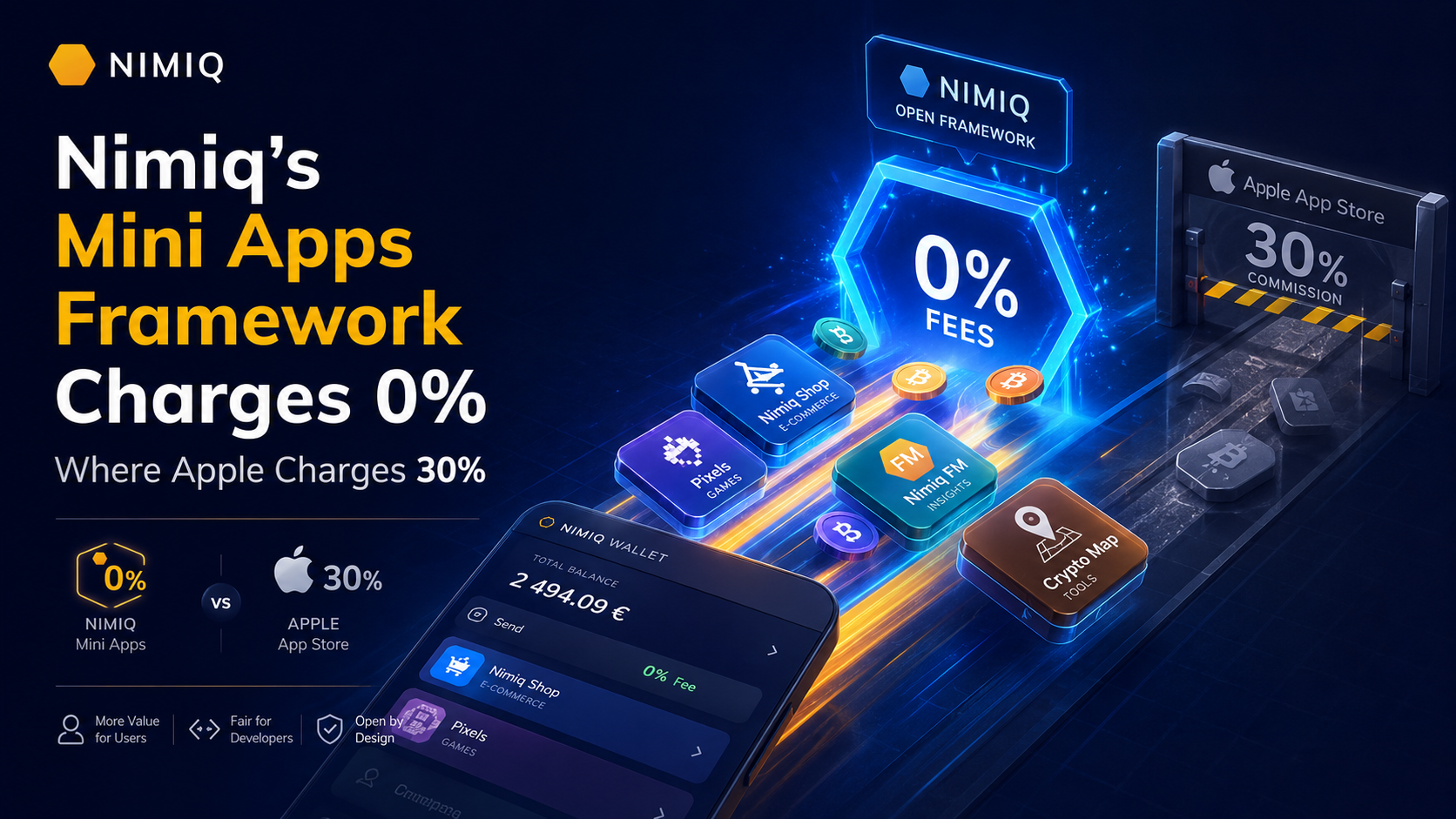
What Nimiq is proposing is that instrument aimed at payments specifically. The Nimiq Pay Mini Apps Framework lets a developer build and host a lightweight web application on their own infrastructure while Nimiq Pay supplies the wallet, the payment rails and the audience. The builder keeps the application, the infrastructure and the intellectual property.
The timing is doing a great deal of work
A zero-commission distribution channel would have been an interesting curiosity in 2019. In 2026 it lands in the middle of the most disrupted year the app economy has had.

For a decade the answer to what a developer paid was thirty per cent, and it was the same answer everywhere. That began to fracture in 2020 when Apple’s Small Business Program cut the rate to 15% for developers under a million dollars a year. The Digital Markets Act opened the European Union to rival stores in March 2024, and the Epic Games Store arrived on iOS there charging 12%. On 30 April 2025 a federal court barred Apple from charging any commission at all on purchases made through external links in the United States, and the Ninth Circuit upheld the contempt finding that December.
The consequences arrived this year. Apple’s US App Store commission revenue has fallen 18% so far in 2026. The standard rate on the China mainland storefront dropped from 30% to 25% in March. In August, Apple restructured its European fees so that third-party app stores pay 5%, told a court it should be permitted between 5% and 15% on external-link purchases depending on the developer’s programme, and watched the European Commission fine Google roughly a billion dollars for its own Digital Markets Act breaches.
What a developer actually pays


Chart 3. Sources: Apple and Google developer terms, European Commission filings, Apple’s August 2026 EU fee announcement, Epic Games Store terms and Nimiq competition rules.
A developer in 2026 can pay 30% on Apple’s standard rate, 26% in India or South Korea under mandated third-party billing rules, 25% on the Chinese mainland, 20% in Europe if they process their own payments, 15% under the Small Business Program, 12% through the Epic Games Store on iOS in Europe or 5% through a third-party European store. Which of those applies depends on where the user lives, which programme the developer joined, how the payment is processed and which court ruled most recently.
Nimiq’s answer to that question is zero, with no submission fee and no revenue share, against the $99 a year Apple charges for a developer account and the $25 Google charges to open one. That is the entire pitch, and its force comes from the fact that the incumbent answer has become impossible to state in a sentence.
The framework also removes the part developers complain about after the commission, which is everything they have to build before they can charge anybody. Nimiq Pay supplies the wallet and the payment functionality at the framework level, so a builder is not standing up payment flows, custody or settlement before shipping a first version. The app now supports USDT alongside NIM across the full Nimiq acceptance network, which means a Mini App can take a stablecoin payment on day one.
Sixty-two submissions, and what the second cycle is really testing
The first cycle is the only evidence anyone has about whether developers want this, and it is more encouraging than the numbers alone suggest.

Sixty-two Mini Apps were submitted in a four-week window, scored by Nimiq’s five-member Community Council, and three won. For a framework nobody had used before, attached to a payment app rather than a social network with a billion users, that is a real result rather than a rounding error.
The rules explain part of why. Prizes are paid in USDT directly to a Nimiq wallet. Every entry needs a public GitHub repository. All submissions go public at the start of week three so the community can test them before judging, which turns the competition into a distribution event rather than a private evaluation. Previous winners can enter later cycles with new applications, though a winning Mini App cannot be resubmitted. Eligible builds include games, productivity tools, marketplaces and social experiences, and participants are explicitly permitted to use AI development tools throughout, which is why the invitation names vibe coders and indie hackers alongside traditional developers.
Cycle II is testing something different from Cycle I. The first cycle asked whether anyone would show up. The second asks whether they come back, and whether the applications get more ambitious now that 62 working examples exist to learn from.
The prize the framework is aimed at

Chinese mini games are on track from $7.65 billion to $9.72 billion between 2025 and 2026. Telegram Mini Apps moved more than $1 billion in 2025 and published estimates put the ecosystem past $5 billion by 2027, a fivefold move in two years. Both are versions of the same insight, which is that an application distributed inside something people already open every day does not have to win an install, an icon or a review queue.
Nimiq is arriving at that market from the payments side rather than the messaging side, which is a narrower base and a more direct one. A Mini App inside a messenger has to find its own way to charge. A Mini App inside a payment app is already standing on the till.
What has to go right
Four questions will decide whether this becomes a platform or stays a competition, and each has a design decision already sitting against it.
Distribution is the first and the largest. Zero commission on a small audience is worth less than 30% on a large one, and the framework’s value to a builder is a direct function of how many Nimiq Pay users there are to reach. Nimiq’s answer is to build the supply side first, on the reasoning that a payment app with hundreds of useful applications inside it is a considerably easier thing to grow than an empty one.
Quality is the second. Sixty-two submissions in four weeks is encouraging and it is also the number a hackathon produces, and hackathon output is not the same as a maintained product. The rules push against this by requiring a public repository and by opening submissions for community testing in week three, both of which favour builders who intend to keep shipping.
Retention is the third. The interesting figure from Cycle II will not be the submission count but the overlap with Cycle I, because a builder returning with a second application is worth more to a platform than two builders who each shipped once. The rules deliberately permit previous winners to re-enter with new work, which is the correct design if repeat participation is what you are optimising for.
Durability of the opening is the fourth. The commission fracture that makes this pitch land is being contested in real time, with Apple’s proposals in front of a district court and the Supreme Court considering a narrow question on the contempt standard. The rates could firm up again. Nimiq’s position is not exposed to that, because a framework that never charged anything does not have a rate to defend, but the urgency of the argument is.
What to watch
The honest read on this is that Nimiq is running a well-understood playbook in a category that has not seen it, and the reason the timing works has less to do with crypto than with the fact that the app store settlement of the last fifteen years is coming apart in public. Apple’s US commission revenue is down 18% in a year. Rival stores are legal in Europe and charging 5%. Courts are now setting the price of a payment the platform never processes. Into that, Nimiq is offering distribution at zero with the payment rails included, and paying builders to try it.
Three things will show whether it lands, and none of them is a prize announcement. The first is the Cycle II submission count set against Cycle I’s 62, because growth or decline in a four-week window is the cleanest read available on whether developers found the first experience worth repeating. The second is how many Cycle I builders return, since repeat participation is what separates a platform from a hackathon. The third is what happens after the third cycle ends and the prize money stops, because a framework that keeps attracting applications without a competition attached to it has become infrastructure, and one that does not was a marketing campaign with good production values.
The App Store comparison Max Burger reaches for is a large claim, and the useful thing about it is that it is checkable. Apple’s store worked because developers could reach users without asking permission from a carrier or a handset maker, and it stopped being universally loved when the toll for that access outgrew what it was buying. Nimiq is offering the first half of that arrangement without the second. Whether enough users arrive to make it worth having is the only question that matters, and the 62 builders who have already shipped are betting it will.
Don’r forget to like and share the story!
Vested Interest Disclosure: HackerNoon has reviewed the report for quality, but the claims herein belong to the author. #DYOR.