A THAAD interceptor costs somewhere between twelve and fifteen million dollars. A Patriot PAC-3 MSE round is listed at roughly $5.3 million in the US Army’s most recent budget request. The FPV drone that a great deal of modern air defense is now being asked to shoot down costs a few hundred dollars and is assembled from commercial parts. Every serious problem in counter-drone defense descends from that single ratio.
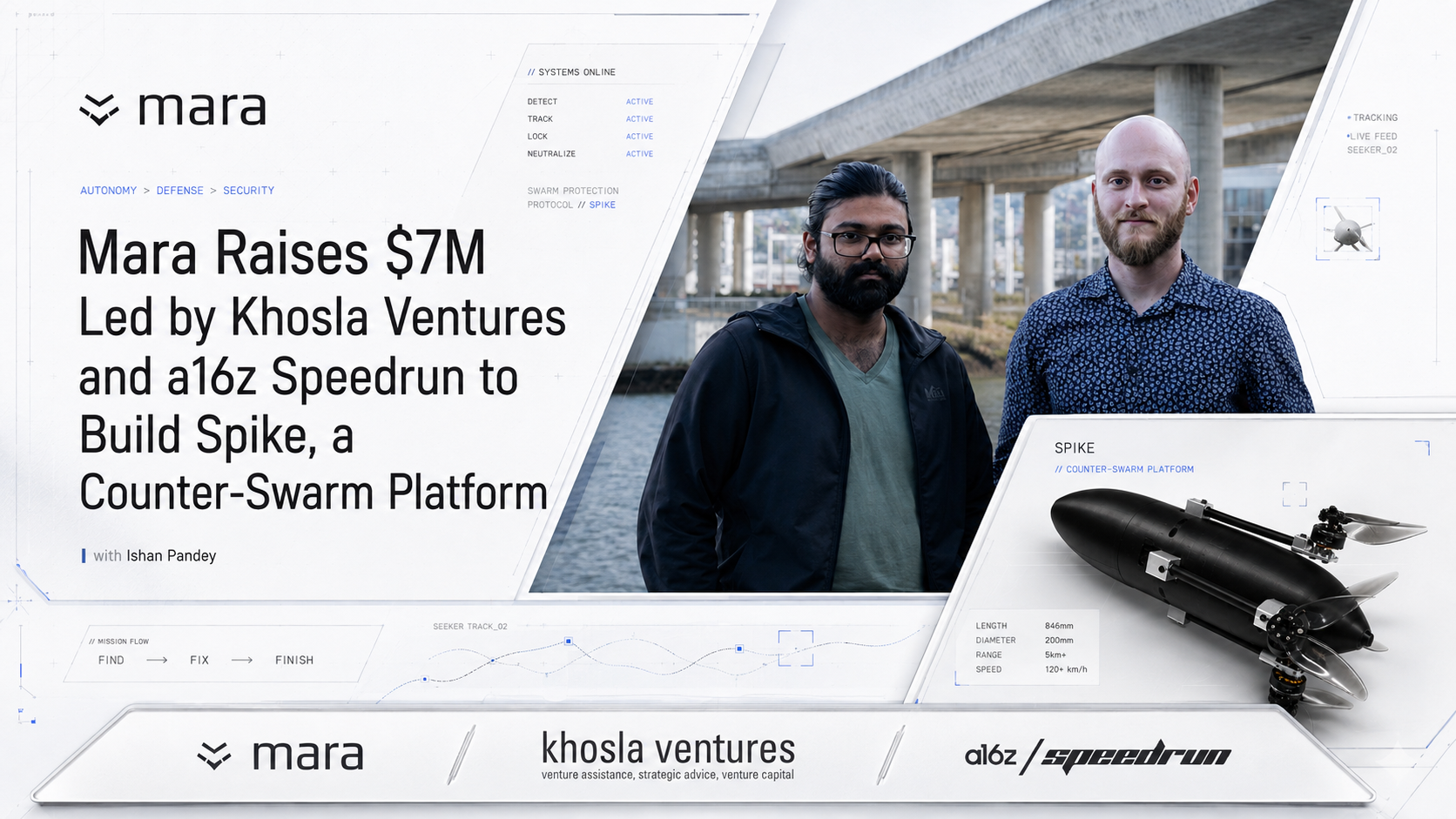
Mara has raised a $7 million pre-seed round led by Khosla Ventures to attack it. The round includes a16z Speedrun, Night Capital, Palmdrive, Protagonist, Freedom Fund and Indicator Fund alongside angel investors. The capital takes Spike, the company’s integrated counter-UAS platform, from field testing toward broad deployment.
https://www.youtube.com/watch?v=Ew8P4REJ0TA&embedable=true
A $500 drone against a $5.3 million interceptor
Air defense has always been expensive and for most of its history that was the correct trade, because the things it shot at were expensive too. An interceptor priced in the millions is rational against a cruise missile or a manned aircraft. It stops being rational the moment the incoming object is a mass-produced airframe assembled from commercial parts and flown by an operator who paid a few hundred dollars for it.

Four orders of magnitude separate the top of that chart from the bottom. The defender pays that spread on every engagement and the attacker pays it once, which is the whole reason this category exists. The industry has been climbing down the ladder for two years. An IRIS-T SL round is about $430,000. A Coyote 2C sits near $125,000, derived from an Army production action of $75 million for 600 rounds. Interceptor-drone programmes are aiming at $10,000 to $50,000 a unit. Each rung down is a company recognising the same arithmetic.
The most consequential line on that chart is not a product. It is the dashed rule at one million dollars, the ceiling the US Army published in June 2026 when it launched a low-cost interceptor programme built explicitly to escape this trap, with a live-fire test scheduled at White Sands. A customer that publishes a price ceiling has stopped expressing a preference and started writing a requirement. For a company whose entire proposition is unit cost, that is the strongest procurement signal available, and it landed two months before this round closed.
Mara is aiming well below the Army’s ceiling. Spike is designed to be attritable end to end, from the sensors through to the interceptors, at a system cost that falls under the value of whatever it is protecting. That is the inversion the category has been waiting for, because a defense that costs less than the thing it defends can be deployed everywhere rather than rationed to the highest-value sites.
Record capital and almost none of it at pre-seed
Founders attacking defense problems in 2021 were pitching into a category most institutional investors would not touch. That constraint is gone.

Venture funding into military, national security and law enforcement startups ran at $1.6 billion in 2020 and sat between roughly $2.8 billion and $3.8 billion a year through 2024. It hit a record $9.6 billion in 2025 and then cleared $14.6 billion in the first five months of 2026, which means the sector broke its all-time annual record before the year was half over. Broader definitions that fold in dual-use technology put 2025 nearer $49.1 billion on PitchBook’s count against $27.2 billion the year before.

Where that money went is the part worth reading. Deal count has stayed close to flat while capital multiplied several times over, and a handful of late-stage names including Anduril absorbed most of the 2026 increase. Capital is abundant at the top of this category and still tightly rationed at the bottom, which is what makes the composition of this round meaningful. A $7 million first cheque led by Khosla Ventures with a16z Speedrun alongside it is not a small round in a crowded field. It is a concentrated bet at the stage where concentration is rarest.
A $12.6 billion market that triples by 2030
Counter-UAS is one of the fastest-compounding line items in defense, and the spending is already ahead of the models built to describe it.

Actual counter-UAS spending is forecast at $12.6 billion in 2026, rising to $24.1 billion by 2030. Across five research houses the median trajectory takes the market from $5.1 billion in 2025 to $17.3 billion in 2030, a rise of 236%, and every single forecast on the page compounds at a double-digit annual rate. The houses count different things and arrive at different levels, which is normal for a category this young, and it changes nothing about the slope. On the most conservative growth rate published by anyone, this market roughly doubles inside five years.
The harder number sits underneath all of it. Publicly announced counter-UAS contracts in the first quarter of 2026 alone exceeded $29 billion. Contract values run across multiple years and annual spending does not, so the two are not directly comparable, and the direction of the gap is unambiguous. Defense ministries are committing to this category faster than the forecasters are modelling it, which is the environment a new entrant wants to be raising into.
https://www.youtube.com/watch?v=DFk-P56ivRY&embedable=true
Twenty-two months of building
Mara was incorporated in California in August 2024 by Daniel Kofman and Sriram Raghu, who met in high school in 2013 and have built together since. Their drone work started with tactical FPV prototypes for a Department of Homeland Security programme, assembled in college dorm rooms. The pair went on to co-found Optivolt, which shipped smart solar panels to Anduril, the US Air Force and Ukraine, which means this is a second hardware company for both of them rather than a first.
What the company has put on the board in the twenty-four months since incorporation is unusual for the stage. Seeker completed intercepts cued through US Army software at an exercise in Texas. Spotter ran hands-free on an armored vehicle at another Army exercise in Europe and fed detections into Army command software. Mara demonstrated an end-to-end engagement with a US special operations unit, with Spotter detecting the target and cueing Seeker without operator input. In July, Ukrainian forces operated Spotter 40km from the front line, where it tracked multiple FPV drones. Alongside the military work there is a civilian pilot at a South Korean port, cooperative research and testing agreements with three US defense organisations, selection for NATO’s DIANA accelerator and early-stage engagement with partners in the UK, the Czech Republic and Ukraine.

Chart 4. Sources: California Secretary of State filing for the incorporation date, and Mara for exercise, pilot and deployment milestones.
That is four theatres, two continents, one civilian vertical and a multilateral accelerator, from a company with a headcount in single digits. The pattern worth noting is not the number of engagements but their type. Each one placed the hardware inside somebody else’s command software rather than alongside it, which is the integration work that usually kills small defense companies at exactly this stage and is far easier to do before a product is frozen than after.
Where the company enters
Military and defense customers account for about 74% of counter-UAS end users. Mitigation and neutralisation is the single largest product category at roughly 42%, ahead of every individual detection, tracking and command segment. North America is about 52% of the geography. Spike’s first configuration is ground-mounted, sold to military customers and built to neutralise rather than only to detect, which puts it in the largest single segment on all three dimensions simultaneously.

Conventional counter-UAS concentrates both replacement cost and line of fire in a single expensive node, which works against one high-flying target and degrades sharply when several small aircraft arrive from different directions at once. Spike distributes both, pairing stationary targeting sensors with a magazine of small interceptors to give one position hemispherical coverage in a portable package. Spotter combines visual, acoustic and optional radar sensing for day, night and all-weather detection. Seeker is a small tube-launched interceptor with onboard intelligence. Launch orders can pass autonomously from one to the other while a human remains on the loop to set rules of engagement and abort if required, which is the design decision that determines whether a system is exportable and procurable rather than merely capable.
https://www.youtube.com/watch?v=DFk-P56ivRY&embedable=true
Scale is handled by configuration rather than by product line, a rucksack-portable version protects a dismounted squad, a vehicle-mounted version covers a convoy and larger deployments can hold multi-kilometre perimeters around bases, front lines, power plants or sporting events. That last list is the commercially interesting one, because it is where the civilian market sits and where the South Korean port pilot is pointing.
What has to go right
Four questions will determine whether this round compounds and each has a design decision already sitting against it. Unit cost at volume is the first and by far the largest. Every claim in the investment case rests on a system price that has so far been demonstrated in field exercises rather than in a production run, and hardware costs fall on manufacturing learning curves that pre-seed companies rarely control. The mitigating factor is that both founders have shipped physical product before at Optivolt, into customers including Anduril and the US Air Force, so this is a second manufacturing problem rather than a first.
Field validation with Army units and a special operations command is the hardest part to fake and the easiest part to stall, because a programme of record moves on a timetable that no startup controls. Mara has hedged that with three cooperative research and testing agreements, a NATO accelerator slot, a civilian pilot and three international engagements, which is a deliberately wide surface for a company of this size and the correct answer to procurement risk at this stage.
The category has serious established players, and the moment a cost-per-engagement argument is proved by a startup is the moment it becomes a roadmap item for firms with far greater manufacturing capacity. The counterweight is architectural rather than commercial, because a distributed attritable design is difficult to retrofit onto a product line built around a single expensive node, and that difficulty is the closest thing to a moat a company at this stage can hold.
Autonomy governance is the fourth and the most consequential over a five-year horizon. Rules of engagement for systems that pass launch orders between machines are being written now in several jurisdictions at once. Keeping a human on the loop for engagement rules and aborts is not only a safety design, it is a market access design, and it is the difference between a system that clears an export review and one that does not.
What to watch
The honest read on this round is that Mara has picked the one problem in air defense where the incumbent economics are indefensible on their own terms, and has arrived with enough field validation to be taken seriously about it. The cost-exchange argument is not a startup talking point. It is the reason the US Army stood up a low-cost interceptor programme with a published price ceiling in June, it is why the industry is already building interceptor drones at a fraction of missile cost, and it is the argument every counter-UAS pitch of the next three years will be graded against. Mara is entering that argument at the lowest price point anyone is currently claiming.
Three things will show whether it lands, and none of them is an announcement. The first is a delivered system price at production volume, because that single number carries the entire thesis and nothing shipped to date has had to survive a manufacturing ramp. The second is whether any of the field validation converts into a programme of record or a foreign military sale rather than another exercise, since exercises demonstrate capability and contracts demonstrate demand, and only one of those funds a factory. The third is the civilian track, because the South Korean port pilot is the tell for whether this is a defense company with adjacent revenue or an infrastructure protection company that started in defense, and those two businesses have very different multiples attached to them.
Underneath the mechanics sits a straightforward proposition about where defense value is moving. For fifty years the advantage belonged to whoever could build the most exquisite system, and cost followed capability because the threats were exquisite too. Small drones inverted that by distributing precise attack across cheap disposable hardware, and defense has spent several years answering a distributed problem with concentrated systems. Mara’s argument is that the answer has to match the shape of the question, which means distributed, autonomous and cheap enough to lose. If that is right, the companies that win this category will look far more like manufacturers than like primes, and the cost line will matter more than the capability line for the first time in the modern history of air defense.
Don’t forget to like and share the story!
Vested Interest Disclosure: HackerNoon has reviewed the report for quality, but the claims herein belong to the author. #DYOR.