Every bank I have worked with has a system nobody wants to touch.
Sometimes it is a mainframe core banking platform written in COBOL. Sometimes it is a card switch that has been processing ISO 8583 messages reliably for twenty years. Sometimes it is a batch file job that runs at 2 a.m. and that exactly one engineer understands. These systems are old, but they are not broken. They move real money every second.
And yet the business wants mobile apps, open banking APIs, real-time payments and cloud analytics. The question is never “should we modernize?” The question is “how do we modernize without taking the ATM network offline on a Friday payday?”
After roughly sixteen years building ATM, POS and digital banking middleware for banks across the Middle East, Asia and Europe, here is what I have seen actually work.
Why “Big Bang” Replacement Fails
The tempting plan is to replace the old core in one program. It rarely goes well. Large core replacements have a long public history of delays, outages and customers locked out of their accounts. The reasons repeat:
- Legacy systems hold undocumented business rules that only appear when the new system gets them wrong.
- Payment flows depend on exact message formats and timing. A field padded differently can cause declines at scale.
- There is no safe rollback once accounts and balances have moved.
The alternative is incremental modernization. Less exciting, far more survivable.
Step 1: Map Every Integration Before You Change One
Before writing new code, build an inventory of every point where systems talk to each other: protocols (ISO 8583, SWIFT MT/MX, ISO 20022, flat files, SOAP, proprietary TCP), message volumes, peak times, and who owns each interface.
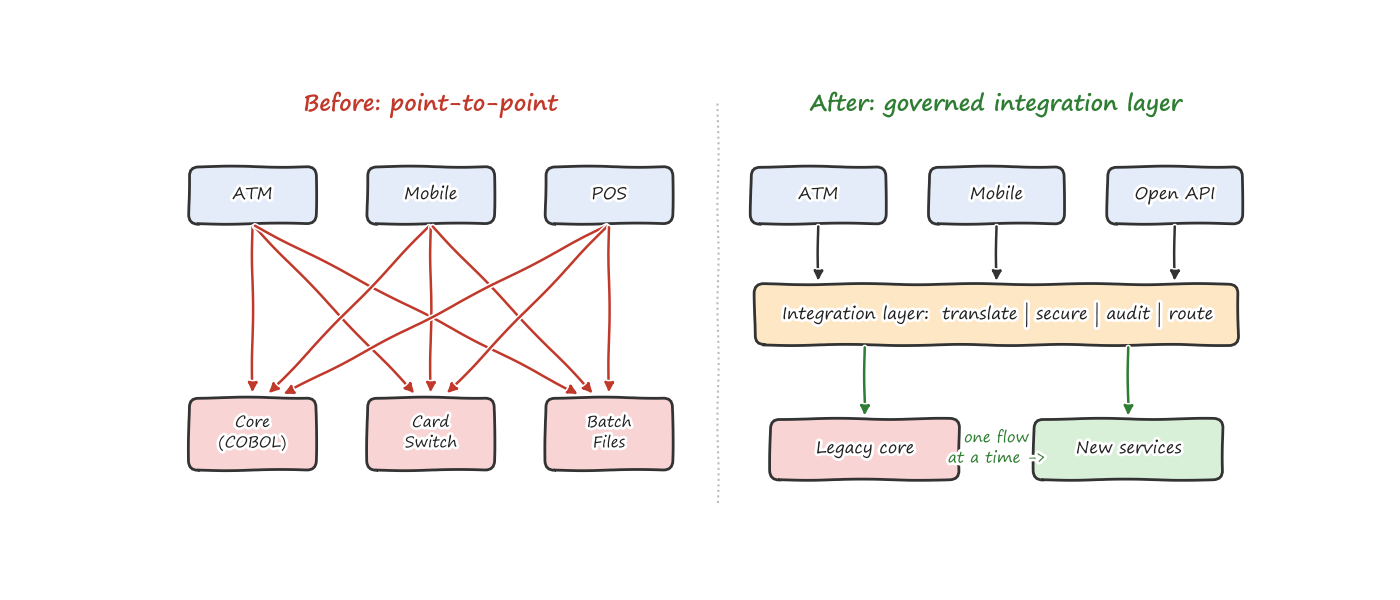
In most banks this map reveals a “spaghetti” of point-to-point links. The ATM switch talks directly to the core. The mobile app calls a SOAP service that calls another SOAP service that writes to a shared database. Every new channel added another direct connection.
You cannot modernize what you have not mapped. You also cannot secure it.
Step 2: Put an Integration Layer in the Middle
The single most valuable move is introducing a governed integration layer between channels and back-end systems. This can be an API gateway plus a payment middleware or message broker, depending on the flow.
The layer does four jobs:
- Protocol translation. Channels speak modern JSON/REST or ISO 20022. The layer translates to whatever the legacy core understands.
- Anti-corruption. Legacy data models (cryptic codes, fixed-width fields) stay behind the layer. New services see clean domain objects.
- Central security controls. Authentication, message validation, rate limiting, encryption and audit logging happen in one place instead of in every point-to-point link.
- Routing. The layer decides whether a request goes to the old system or the new one. This is what makes gradual migration possible.
Step 3: Strangle One Flow at a Time
With the layer in place, use the strangler fig pattern: move one business flow at a time from legacy to new, while the rest keeps running untouched.
A typical order that has worked for me:
- Read-only flows first (balance inquiry, transaction history). Low risk, high volume, great for proving performance.
- Low-value write flows (beneficiary management, card limits).
- Payment flows last, starting with a single channel or a single BIN range.
For each flow, run the new path in shadow mode first: send traffic to both systems, compare results, and only switch over when mismatches are near zero. Keep the routing switch reversible for weeks, not hours.
Step 4: Do Not Lose Security in Translation
Integration layers are where security quietly degrades. Patterns I see repeatedly:
- Decrypt-and-forget. PIN blocks or card data are decrypted for translation and then logged or passed onward in clear. Sensitive data should be translated inside an HSM or tokenized, never handled in application memory longer than necessary.
- Trusted internal network assumption. Legacy links often have no authentication because “it is inside the data center.” When the same link is exposed through an API, that assumption becomes a vulnerability. Apply mutual TLS and message authentication on every hop.
- Lost audit trail. The legacy system logged by terminal ID, the new one by API client. Without a shared correlation ID, incident investigations hit a wall.
This matters well beyond one bank. In the United States, CISA identifies financial services as critical infrastructure, and regulators such as the FFIEC and OCC have repeatedly flagged third-party and legacy integration risk. As U.S. banks connect older cores to real-time rails like the Federal Reserve’s FedNow Service and to ISO 20022 messaging, the integration layer becomes the front line of payment security.
Step 5: Reconcile Old and New Continuously
During migration, two systems may each believe they own the truth. Automate reconciliation between legacy and new ledgers daily at minimum, and in near real time for payment flows. Every mismatch is either a migration bug or a hidden business rule you did not know about. Both are worth finding before customers do.
Step 6: Plan the Exit, Not Just the Entry
Teams celebrate when the new system goes live and forget to decommission the old path. Two systems running forever means double the attack surface and double the cost. For each migrated flow, define:
- The date the legacy path is switched off
- Who confirms no traffic is still reaching it
- How long data is retained for audit
The Real Lesson
Legacy banking systems are not the enemy. They are proof that something worked for decades. Modernization succeeds when it respects that, puts a disciplined integration layer between old and new, moves one flow at a time, and treats security and reconciliation as part of the design.
The banks that get this right do not make headlines. Their customers simply never notice the migration happened. That is the goal.