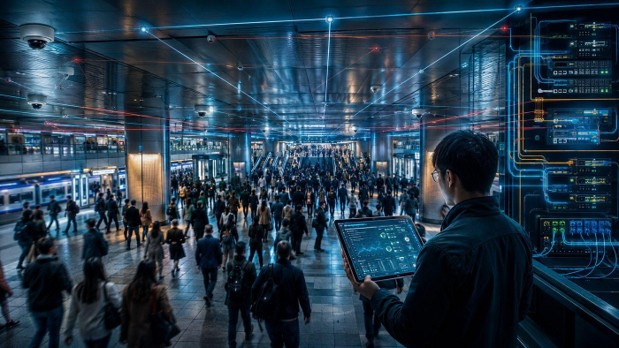
If you have ever hurried through a major transit hub at rush hour, you probably noticed the crowd, the signs, and the train you were about to miss. You probably did not notice the security network quietly moving video, alarms, sensor data, and operator commands behind the walls.
That is exactly how it should feel. The system is doing its job when thousands of people can move through the space while security teams still get clear, timely information.
I worked on intrusion-detection and security-system engineering for two of the highest-traffic transit hubs in the country. The interesting part was not installing more devices. It was making a large collection of cameras, sensors, switches, fiber paths, control points, and operator workflows behave like one dependable system in a place that never truly becomes quiet.
The Crowd Is the Load Test
At a smaller site, you can test a camera view with a few people walking through it. You can trigger an alarm, watch it appear at the console, and feel reasonably confident that the path works. A high-density hub is different because the environment itself becomes a source of noise.
People bunch together, split apart, stop suddenly, carry luggage, block sightlines, and move in opposite directions. Reflections change as trains arrive, doors open, and advertising displays cycle. A detection rule that looks perfect at 2 p.m. can become useless at 5:30 p.m.
That changed how I thought about validation. The crowd was not something to work around after the technical testing. The crowd was part of the technical testing.
I Started With the Information Journey
It is tempting to begin with device counts and floor plans. I found it more useful to begin with a simple question: what information must reach which person, how quickly, and what happens if one part of that journey fails?
For an intrusion event, the journey might start at a sensor, pass through a local controller and network switch, cross a fiber path, reach a management system, and finally appear for an operator. The return journey matters too because the operator may need to acknowledge the alarm, bring up the right camera, or send a command back to the field.
Once I drew those journeys, hidden dependencies became obvious. A sensor could be healthy while its uplink was congested, or a camera could stream normally while the alarm-to-video association was wrong. Device status alone never told the whole story.
The Network Was the Security System
People often talk about cameras and intrusion sensors as the security system, then describe the network as supporting infrastructure. In a large transit hub, that distinction falls apart. If the network cannot deliver the event at the right time, the field device might as well be offline.
I treated bandwidth, switching, addressing, time synchronization, segmentation, and path diversity as security requirements. Video creates steady traffic, while alarms create smaller but urgent bursts. Maintenance tools and management traffic also compete for capacity, so the design has to protect the important flows without making the network impossible to operate.
This is where simple diagrams can be misleading. Two lines on a drawing may look redundant but still share one conduit, power source, room, or upstream switch. I learned to trace physical and logical dependencies together because a shared failure point does not care which diagram it was omitted from.
Redundancy Had to Survive Messy Failures
Real failures are rarely as neat as pulling one cable during a demo. A switch can stay powered but stop forwarding correctly, a fiber path can degrade rather than disappear, and a field cabinet can overheat while every status light still looks reassuring.
The goal was graceful degradation, not a fantasy of zero failure. NIST’s cyber-resiliency guidance uses a helpful idea: systems should anticipate, withstand, recover from, and adapt to adverse conditions. That same mindset works well for physical-security networks.
For me, that meant testing partial failures and awkward combinations. We looked at what operators would still see, which alarms would be delayed, how traffic would reroute, and whether the system would tell anyone that it was operating with reduced protection.
Detection Accuracy Changed With the Environment
Intrusion detection is not just a sensor problem. It is a full-scene problem that includes mounting, geometry, lighting, vibration, airflow, passenger behavior, cleaning routines, and maintenance access. A technically sensitive system can still be operationally poor if it alarms so often that people stop trusting it.
I cared about false positives because every unnecessary alarm consumes attention. I cared just as much about false negatives because a quiet system is not automatically an accurate one. The useful target was a detection setup that remained understandable to operators during the busiest periods, not a lab result achieved in an empty space.
We validated zones under different crowd conditions and checked whether the associated video actually helped someone understand the event. If an alarm sent an operator to the wrong view, arrived without context, or used a label nobody recognized, the technical chain was incomplete.
I Tested the Alarm Chain, Not the Components
Component tests still mattered, but they were only the beginning. I wanted to see the entire sequence: detection, transport, display, operator acknowledgment, video call-up, logging, and recovery. That end-to-end test exposed the integration mistakes that individual device checks missed.
Timing was especially important. A few seconds of delay can feel small on a spreadsheet, yet it changes how an operator interprets a fast-moving event. We measured the experience at the console, not only the response time of each box along the path.
Commissioning Happened in a Live World
A busy transit hub does not become a laboratory just because engineers arrive with a test plan. Work windows are limited, passenger routes change, other construction continues, and operations teams still have a public service to run.
I broke commissioning into repeatable stages and made each handoff explicit. We verified the field device, local network path, upstream route, management-system mapping, operator display, and failure behavior in sequence. When a stage failed, we knew where to look instead of reopening the entire chain.
The Biggest Lesson Was Surprisingly Simple
The hardest part of protecting a maximum-throughput public space is not choosing the smartest device. It is preserving trustworthy information from the edge of the station to the person who must act on it, even when the environment is crowded, noisy, partly degraded, and changing around you.
If I had to reduce the whole project to one rule, it would be this: test the system in the world it will actually serve. An empty platform can prove that the equipment turns on, but only a real crowd can prove that the security system works.