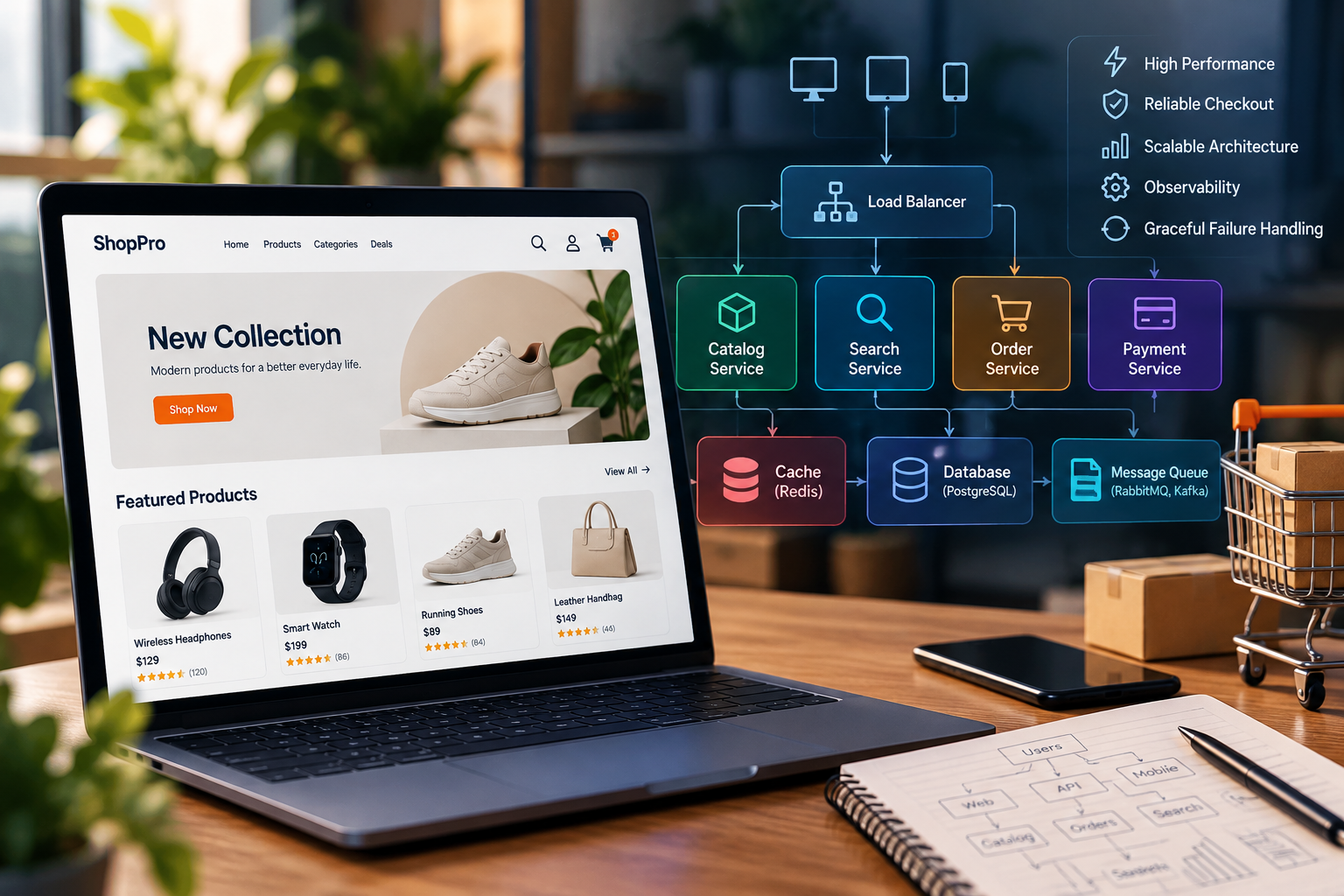
A practical guide to designing an online store that remains fast, consistent, and maintainable as catalog size, traffic, and business rules grow
Building an e-commerce site is easy to underestimate. A catalog, product page, cart, and checkout can look like a straightforward CRUD application, but the engineering constraints are very different from those of a typical content site.
The moment real traffic, inventory, promotions, payments, search, user accounts, and third-party integrations appear, the system becomes a distributed application with multiple consistency boundaries.
The important question is therefore not just “How do we build an online store?”
How do we design an e-commerce system that stays responsive under load, keeps money and inventory correct, and remains understandable six months after launch?
This article walks through that problem from an engineering perspective.
1. Start With Domain Boundaries, Not Frameworks
A common failure mode is choosing a stack first and defining the business model later. Frameworks are implementation details; domain boundaries are architectural decisions.
A practical e-commerce platform usually contains at least these logical areas:
Catalog
  ├── Products
  ├── Categories
  ├── Attributes
  └── Pricing

Customer
  ├── Accounts
  ├── Addresses
  └── Sessions

Commerce
  ├── Cart
  ├── Orders
  ├── Payments
  ├── Discounts
  └── Inventory

Platform
  ├── Search
  ├── Notifications
  ├── Analytics
  └── Admin
These do not have to become separate microservices. A modular monolith can keep the same domain boundaries while deploying as one application.
That distinction matters. Splitting a poorly defined codebase into ten services usually creates ten poorly defined services plus network failure modes.
A good first architecture often looks like this:
Browser / Mobile Client
        |
        v
CDN / Edge Cache
        |
        v
Web Application / API
        |
  +-----+------+---------+---------+
  |            |         |         |
  v            v         v         v
PostgreSQL    Redis    Search    Queue
  |                      |
  +----------+-----------+
             |
             v
       External Services
    (Payment, Shipping, Email)
The design phase should make these boundaries explicit before implementation starts. For teams evaluating the product and UX layer as well as the technical layer, a practical reference is e-commerce website design, particularly when requirements include catalog structure, conversion flows, and responsive storefront behavior.
2. Separate Read-Heavy and Write-Critical Workloads
E-commerce systems have an uneven workload.
Product listing pages may receive thousands of reads while inventory updates, order creation, and payment confirmation occur comparatively infrequently but require stronger correctness guarantees.
That means one generic data-access strategy is usually inefficient.
Read-heavy paths
Typical read-heavy operations include:
- category pages
- product details
- search results
- navigation menus
- related products
- static configuration
These are excellent candidates for caching, precomputation, and denormalized read models.
Write-critical paths
The dangerous operations are different:
- reserving inventory
- creating an order
- recording payment state
- applying a one-time coupon
- issuing refunds
These operations need transactional thinking.
A product page can tolerate a cache miss. A checkout operation cannot silently create two orders for one payment.
3. Caching Without Creating a Consistency Problem
Caching is often introduced as a performance feature and only later treated as a data-consistency problem. In e-commerce, that order should be reversed.
A useful cache hierarchy is:
Browser Cache
      |
      v
CDN / Edge Cache
      |
      v
Application Cache (Redis)
      |
      v
Database
The closer the cache is to the user, the cheaper the read. The closer the system is to the source of truth, the stronger the consistency.
For example, a product description can safely have a longer cache lifetime than inventory.
product:{id}        -> long TTL
category:{id}:page  -> medium TTL
inventory:{sku}     -> very short TTL or event-driven invalidation
cart:{session_id}   -> user/session scoped
A good cache key should encode enough context to prevent collisions:
product:v3:us:en:sku-1842
Versioning cache keys becomes especially useful during schema or serialization changes. A deployment that changes JSON shape should not accidentally deserialize stale entries created by an older version.
Recent HackerNoon engineering discussions also highlight why cache layers create operational complexity rather than simply making systems “faster”; the same concerns show up in production e-commerce systems. The Many Layers of Caching is a useful companion read.
4. Product Search Should Be Designed as a Subsystem
Search becomes a system of its own surprisingly early.
A basic SQL query can work well at first:
SELECT id, name, price
FROM products
WHERE name ILIKE '%' || :query || '%'
ORDER BY popularity DESC
LIMIT 20;
But as requirements grow, search usually adds:
- typo tolerance
- stemming
- synonyms
- faceting
- filters
- sorting
- ranking
- autocomplete
- personalization
- availability constraints
At that point, forcing every concern into relational SQL becomes difficult to maintain.
A more scalable architecture is:
Primary DB
   |
   | domain events
   v
Indexing Worker
   |
   v
Search Index
   |
   v
Search API
The database remains the source of truth. The search index becomes a derived read model.
This distinction is critical because search indexes can lag behind transactional data. Your application must decide what “fresh enough” means for each use case.
A recent HackerNoon case study on search across large numbers of storefronts discusses how on-site search can become an engineering bottleneck long before teams expect it to. What Running Search Across Hundreds of Storefronts Taught Us is particularly relevant here.
5. Inventory Requires Stronger Guarantees Than Catalog Data
Inventory is where many apparently fast systems become incorrect.
Suppose two customers request the final unit at nearly the same time:
Customer A -> read stock = 1
Customer B -> read stock = 1
Customer A -> buy
Customer B -> buy
A naïve read-then-write sequence can oversell the product.
One option is an atomic conditional update:
UPDATE inventory
SET available = available - 1
WHERE sku = :sku
  AND available > 0;
Then verify the affected row count.
row_count = 1  -> reservation succeeded
row_count = 0  -> inventory unavailable
This is often safer than first reading inventory and assuming the value remains valid during the next operation.
For more complex reservation workflows, use a short transaction and explicitly model states such as:
AVAILABLE
   |
   v
RESERVED
   |
   +------> RELEASED
   |
   v
COMMITTED
The important point is that inventory should have a state machine, not merely an integer.
6. Checkout Is a Distributed Transaction
Checkout often touches multiple systems:
Cart
  |
  v
Inventory
  |
  v
Order
  |
  v
Payment Provider
  |
  v
Shipping
  |
  v
Email / Notifications
You cannot assume that all of them succeed or fail together.
For example:
Order created       = success
Payment authorized  = success
Shipping API        = timeout
Email API           = timeout
The order should not be deleted just because notification delivery failed.
Instead, each operation should have its own state and retry semantics.
A simplified order state machine might be:
PENDING_PAYMENT
       |
       +----> PAYMENT_FAILED
       |
       v
PAID
       |
       v
FULFILLMENT_PENDING
       |
       v
SHIPPED
       |
       v
COMPLETED
This is also why asynchronous messaging becomes useful. Non-critical side effects such as email, analytics, or webhook delivery can move to a queue so the customer-facing request does not depend on every external service completing synchronously.
7. Idempotency Prevents Duplicate Orders
Retries are inevitable. Mobile networks fail. Browsers refresh. Users double-click. Payment gateways retry callbacks.
If an operation is not idempotent, a retry can create duplicate business effects.
For example:
POST /api/orders
Idempotency-Key: 8b9f3a5e-...
The server can store the result associated with that key:
idempotency_key
      |
      +--> request fingerprint
      +--> response
      +--> status
      +--> expires_at
If the same key is received again, the server returns the original result instead of creating another order.
This pattern is especially important around payment and order creation.
8. Design the Frontend Around Failure, Not Only Success
A production UI needs more states than “loading” and “loaded”.
A useful model is:
idle
loading
ready
refreshing
empty
error
stale
retrying
Consider a category page during a temporary API failure.
Showing a blank white screen communicates nothing. A better design might keep the last successful data visible and expose a recoverable error state:
STALE DATA

Products shown from the last successful fetch.

[Retry]
This is particularly important for e-commerce because users often reach product pages from external links, search results, campaigns, or saved bookmarks.
When the interface has to support complex business rules, localized content, responsive layouts, and custom workflows, the engineering requirements should be reflected in the product-design process as well; this is where custom website development can be relevant as a broader implementation model rather than treating the storefront as a generic template.
9. Observability Should Be Part of the Architecture
A system is not production-ready merely because it works on a developer laptop.
You need enough telemetry to answer questions such as:
- Which endpoint is slow?
- Is latency coming from the database or a third-party API?
- Did cache hit rate collapse after deployment?
- Are payment failures increasing?
- Are search requests timing out?
At minimum, collect:
Metrics
  - request latency
  - error rate
  - cache hit ratio
  - queue depth
  - DB connection utilization

Logs
  - structured JSON
  - correlation/request IDs
  - business event IDs

Traces
  - API -> service -> DB
  - API -> payment provider
  - API -> search service
A request ID that travels through the entire stack is particularly valuable:
Browser
  request-id: 7f42...
       |
       v
API Gateway
       |
       +--> Order Service
       |       |
       |       +--> PostgreSQL
       |
       +--> Payment Provider
Now one failed checkout can be reconstructed from a single correlation identifier.
10. Performance Work Should Be Measured
Avoid optimizing based on intuition.
Measure:
- server response time
- database query latency
- cache hit ratio
- JavaScript execution time
- image transfer size
- largest contentful paint
- interaction latency
- search latency
- checkout completion time
The correct optimization target is often not where developers expect it to be.
For example, reducing a SQL query from 30 ms to 10 ms is irrelevant if the endpoint waits 800 ms for a slow third-party shipping API.
A recent HackerNoon analysis of performance optimization at very high request volumes is a useful reminder that apparently obvious optimizations can produce unexpected trade-offs. Why “Obvious” Performance Optimizations Often Backfire explores this problem from a production-systems perspective.
11. Security Is an Architectural Constraint
An e-commerce system processes more than browsing data. It may handle personal information, addresses, order history, authentication tokens, and payment-related states.
Security controls should therefore appear in the architecture itself:
Browser
  |
HTTPS + secure cookies
  |
API
  |
Authorization middleware
  |
Domain services
  |
Parameterized DB access
Common implementation requirements include:
- parameterized database queries
- CSRF protection where cookie-based authentication is used
- secure and HttpOnly cookies
- rate limiting
- server-side authorization checks
- input validation
- secret management outside source control
- audit logging for sensitive administrative actions
- strict webhook signature verification
A hidden form field or frontend validation rule is not an authorization boundary. The server must enforce business permissions.
12. Where a Monolith Ends and a Service Boundary Begins
Microservices are useful when independent scaling, ownership, deployment, or fault isolation justifies the additional complexity.
They are not a mandatory maturity milestone.
For many stores, a well-structured modular monolith is a better first architecture:
src/
  catalog/
  customers/
  cart/
  orders/
  inventory/
  payments/
  search/
  notifications/
Each module should expose clear interfaces and avoid reaching into another module’s tables or internal classes without a defined contract.
Later, if search needs a separate scaling profile, it can become a service because the boundary already exists conceptually.
That is a healthier migration path than beginning with distributed systems merely because the architecture diagram looks impressive.
13. A Practical Production Checklist
Before calling an e-commerce platform production-ready, verify:
[ ] Domain boundaries are explicit
[ ] Read-heavy paths have an intentional cache strategy
[ ] Inventory writes are atomic or transactional
[ ] Order creation is idempotent
[ ] Payment callbacks are safely retryable
[ ] Search is treated as a derived read model when necessary
[ ] External-service failures have bounded impact
[ ] Frontend states include empty, stale, and recoverable error states
[ ] Logs contain correlation IDs
[ ] Key business metrics are monitored
[ ] Sensitive operations are authorized server-side
[ ] Database migrations are repeatable
[ ] Load tests cover the checkout path
[ ] Rollback/deployment procedures are documented
The goal is not to maximize architectural complexity. The goal is to make the system’s important guarantees explicit.
Conclusion
A production-grade e-commerce platform is fundamentally a reliability problem disguised as a website project.
The catalog can be simple. The hard parts appear when traffic increases, inventory becomes scarce, payments can timeout, search indexes lag, caches become stale, and multiple services have to participate in one customer journey.
The strongest architecture is usually the one that makes these failure modes visible and manageable:
- Separate business domains from framework code.
- Optimize reads without weakening write-critical consistency.
- Treat caching as a consistency problem as well as a performance tool.
- Model inventory and checkout as explicit state machines.
- Make retryable operations idempotent.
- Design UI states around partial failure instead of only the happy path.
- Instrument the system before production incidents force you to.
- Prefer a modular monolith until there is a measurable reason to distribute it.
Once those principles are in place, the choice of framework, database, search engine, hosting platform, and frontend stack becomes an implementation decision rather than an architectural gamble.
References and Further Reading
- HackerNoon: Building Scalable E-commerce Infrastructure on Magento
- HackerNoon: The Many Layers of Caching
- HackerNoon: What Running Search Across Hundreds of Storefronts Taught Us
- MDN: HTTP Caching
- web.dev: Core Web Vitals
- OWASP: E-Commerce Security
Disclosure: This article includes two contextual references to AzkiWeb resources because they are directly related to the web design decisions discussed below. They are not required to understand the engineering concepts in this guide.