Saudi Arabia awarded $196 billion of giga-project construction contracts in 2025, a fifth more than the year before, with another $431 billion of announced investment along the Red Sea coast still waiting to be tendered. Every one of those contracts turns into thousands of orders for cement, steel bars, gravel and tiles, most of them still priced the old way: a site manager calls four suppliers, collects four numbers over WhatsApp and picks one without ever knowing whether he overpaid.
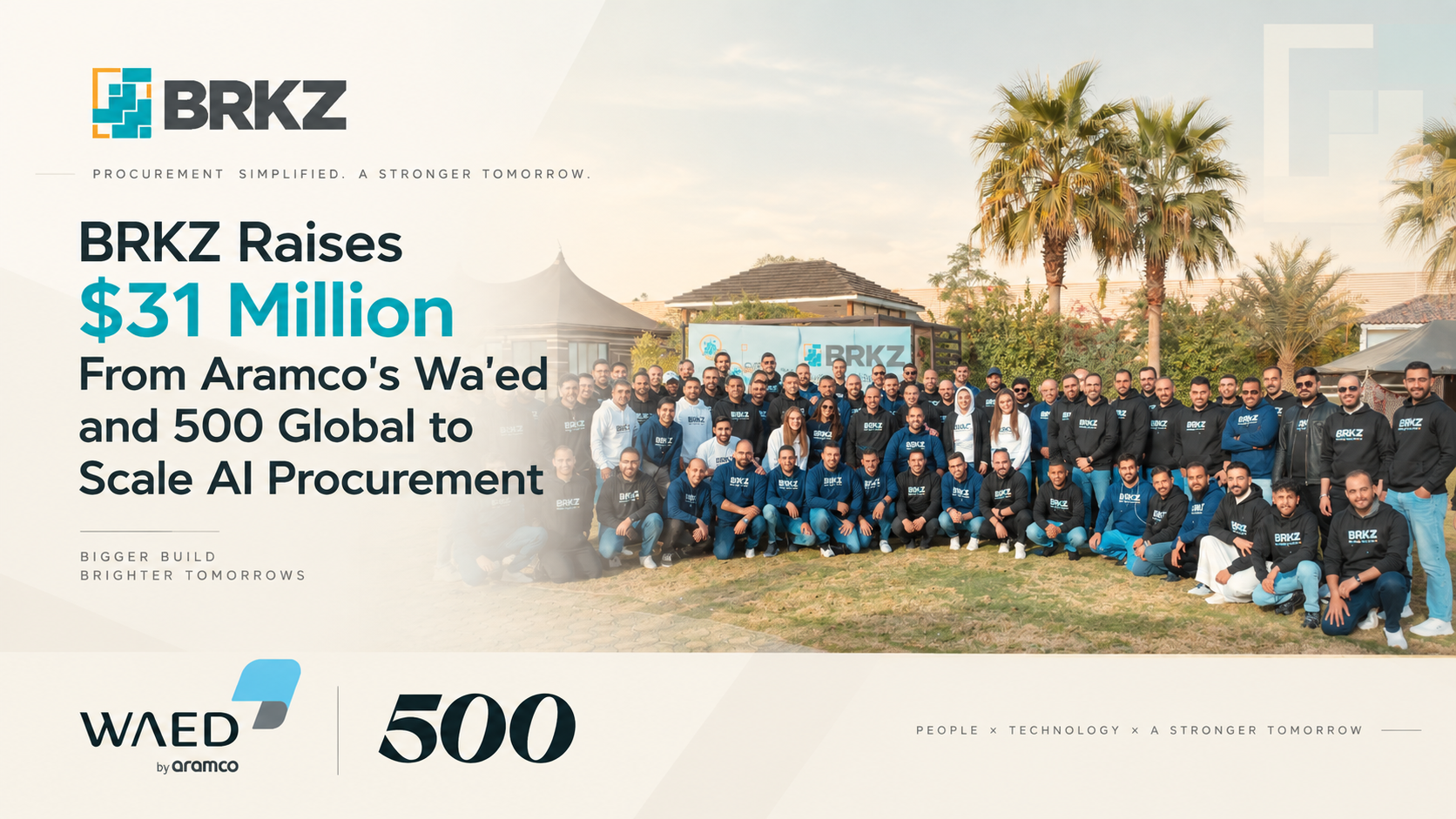
BRKZ has been quietly collecting those numbers for four years. It has priced $1.37 billion of quote requests since 2022, sold $133 million of materials off the back of them and grew revenue four times over in 2024 then 2.5 times in 2025 while the sea routes feeding the Kingdom were being redrawn. Today it has $31 million more to spend: a $13 million Series B co-led by Aramco’s Wa’ed Ventures and 500 Global, with BECO Capital and Anb Seed Fund participating, plus $18 million of growth debt that Stride Ventures has committed under the $30 million facility the two sides agreed last October. The round is still open, so expect more names on it before the year ends.
https://www.youtube.com/watch?v=Dm6cqKWH6pg&t=62s&embedable=true
Why more than half of this round is a loan
Read the $31 million carefully and it splits into $13 million of equity, which buys investors a share of the company, plus $18 million of debt, which BRKZ has to pay back. Startups usually avoid debt because lenders want cash flow, not promises.
BRKZ wants it because of how its customers pay. A contractor buying rebar for a Diriyah site expects sixty or ninety days to settle the bill, while the factory that rolled the steel wants its money on delivery. Someone has to fund the gap in between.

BRKZ has decided that someone should be BRKZ. That turns a marketplace into a lender. Lenders need loan books, which is why Stride Ventures, a firm that has backed the same playbook in India, agreed to a $30 million line last October when the company had raised only $22.5 million of equity in its life. The road here has six stops: a $5.55 million seed from Better Tomorrow Ventures, an $8 million Series A1 in March 2024 that took the company out of stealth, an $8 million Series A2 with $1 million of Capifly debt in early 2025, the Stride facility, a strategic cheque from SIC, the investing arm of the Saudi Industrial Development Fund, in April 2026 and now the Series B. The disclosed tranches add up to $65.6 million; the undisclosed SIC amount takes the company past the $70 million it reports.
From 350 suppliers to 2,100 in thirty months
When BRKZ came out of stealth in March 2024, the app listed around 1,200 products from 350 suppliers and had handled a bit over $170 million of quote requests. Thirty months on, the supplier count is about 2,100, the catalogue has more than 13,000 product records and the quote volume has passed $1.37 billion, which works out to growth of six to eleven times depending on which number you pick.

The customer side is now more than 1,500 contracting companies and 150 factories. The factories are the clever part because a cement plant does not only sell through BRKZ, it also buys its raw inputs through BRKZ, so every factory that signs up adds supply for the contractors already on the app while adding demand for the raw-material suppliers upstream. That two-way loop is what SIC was paying for in April; its chief executive put the case plainly: the biggest problem for Saudi factories is finding buyers, not finding money. A platform with 1,500 contractors on it is a buyer-finding machine.
The Year That Should Have Hurt: Navigating the War in Iran
BRKZ grew revenue 4x in 2024, then 2.5x in 2025 and says 2026 is tracking toward 3x. Stack those multiples on top of each other and revenue in 2026 lands at thirty times what it was in 2023, for a business that ships physical goods on trucks. The 2025 figure is the one that tells you something, because 2025 was the year Gulf shipping, insurance and supplier lead times all got repriced by conflict in the region.

Indexed revenue built from company-disclosed year-on-year multiples, 2023 = 1. Sources: BRKZ company disclosures, October 2025 and September 2026.
When materials get scarce, contractors go back to whoever can actually deliver which is usually the old supplier relationship, the cousin with a truck. But here…..they did not. They ordered more through the app. That is the difference between a price-comparison website and a supply chain. It is hard to fake.
Ten dollars quoted for every dollar sold is the whole point
Since 2022 BRKZ has priced $1.37 billion of requests and sold $133 million of materials. So roughly a tenth of everything quoted on the platform turns into an order. On a phone-and-WhatsApp procurement desk that ratio is normal, because a contractor asks five suppliers to price the same steel and only one of them wins. The difference is that when the losing quotes happen on BRKZ, they do not vanish.

Cumulative request-for-quotation volume versus cumulative materials sold since inception, US$ millions. Source: BRKZ company disclosures, September 2026.
Each one is a timestamped record of what a particular product cost, from a particular supplier, delivered to a particular city, in a particular week. Four years of that adds up to about 38 million structured data points across 13,000-plus product records and 2,100-plus supplier profiles. No competitor can buy that dataset. No contractor has one. It is the raw material for the pricing model that this round is really funding. The job of that model is simple to state: shrink the gap between the $1.37 billion and the $133 million.
What the AI does on a Tuesday morning
Strip the word AI out and describe the jobs. The pricing model has been trained on about 40,000 quote requests and, for each new order, predicts what BRKZ should pay the supplier, what it should charge the contractor and which suppliers should get the request. Between 84 and 89 percent of those predictions land within 5 percent of the price the deal actually closes at. A procurement officer who used to spend an afternoon on the phone now gets a number in seconds and decides whether to accept it. The second job belongs to Nusa, an agent that handles bulk cement.
A truck driver drops a load, photographs the paper delivery note, sends it on WhatsApp; Nusa reads the photo, finds the matching order, checks the tonnage and closes the delivery. About three-quarters of deliveries now clear this way without anyone at BRKZ touching them; the rest get flagged to a person. The third job is credit. When a contractor asks for ninety-day terms, a model scores the request against BRKZ’s own history of who pays on time, then a human in finance signs off. In all three cases the machine handles volume and a person keeps the final decision, which is the version of AI that lenders and insurers are comfortable with.

Disclosed automation and accuracy rates across quotation, fulfilment and credit, with the underlying data asset. Source: BRKZ company disclosures, September 2026.
The founder’s argument
Ibrahim Manna, who founded BRKZ in 2022, is a three-time logistics founder and former Careem executive. The company is built the way a logistics person would build it: trucks, warehouses and supplier contracts first, clever software second. His account of the past year is that contractors and factories never stopped needing three things, materials they could rely on, prices they could trust and deliveries that showed up.
A disrupted region made those needs sharper rather than smaller. His account of the next phase is about sequencing. The first four years went into the supply network, the logistics and the data. Only now, with all of that in place, does it make sense to put a smarter layer on top. Only now can the company push beyond Saudi Arabia into the rest of the Gulf without the network snapping.
Who is writing the cheques
Wa’ed Ventures is Aramco’s $500 million venture fund, holds more than 100 portfolio companies and exists to build Saudi businesses outside oil. It first invested at the Series A1 and is now co-leading, with chief executive Anas Alghatani framing the investment around procurement that is more efficient, connected and data-driven. 500 Global manages $2.1 billion and has backed more than 5,000 founders in 80-plus countries; it is a new lead here.

Managing partner Amjad Ahmad’s reasoning is that building materials is one of the largest and least digitized categories in the Saudi economy, with BRKZ’s growth through the disruption as proof the team can execute. BECO Capital of Dubai co-led the A1, came back for the A2 and is in for a third time. Anb Seed Fund puts a Saudi bank on the cap table; anb Capital chief executive Khalid S. Alghamdi points to the SAR 5 billion of processed quotes as the evidence of scale. Behind the equity sit two strategic players: Stride Ventures, whose $18 million turns a signed facility into money on the balance sheet, together with SIC, which is building an alternative-investment book of roughly $425 million this year and picked BRKZ as one of its direct industrial holdings.
The biggest construction site on earth is mostly still on paper
Saudi Arabia is building more than any other country right now. The figures that matter for a materials seller are the ones describing what has not been built yet. Knight Frank counts $196 billion of giga-project contracts awarded in 2025 and expects the Kingdom’s total construction output to reach $191 billion a year by 2029. On the Red Sea coast, 17 giga projects carry $431.3 billion of announced investment, of which $57 billion has been awarded, so 13 percent.

Announced giga-project investment versus construction contracts awarded, by region, US$ billions. Source: Knight Frank Saudi Arabia Giga Projects Report 2025 via Arab News and Zawya.
Around Riyadh, $237 billion has been announced and $44 billion awarded, so 19 percent, with Diriyah alone holding $45.6 billion in the pipeline. Knight Frank’s earlier tally put the whole programme at more than SAR 1.25 trillion launched and not yet delivered. BRKZ already supplies contractors on The Red Sea Project, Diriyah, Qiddiya, ROSHN and King Salman Park, which puts it on both of the geographies where the unawarded money is largest. Vision 2030 fixes the deadlines, Expo 2030 and the 2034 World Cup fix the later ones and none of those dates move, which means the contract awards keep coming whether or not the region has a calm year.
Where the $31 million goes
Three places. First, the AI layer: more of the quote-price-deliver journey handled by models, so the platform can process far more orders without hiring in proportion. Second, going deeper into the chain in both directions, up into raw-materials sourcing and down into last-mile delivery, because that is where a physical-goods marketplace earns its margin and its reputation across 40-plus delivery cities.
Third, cross-border trading: direct supply corridors with China, India and other manufacturing hubs, including specialty and private-label products, so that a Saudi contractor’s order does not depend on one route staying open. The embedded-financing product, funded by the Stride debt, runs underneath all three, because a contractor who gets ninety-day terms from BRKZ is a contractor who does not shop around. The company was picked for the Saudi Unicorns Program in 2025, has $12 million of the Stride facility still to draw, has a state industrial fund as a shareholder and has left the Series B open, which is a fairly clear signal about how it expects the next few months to go.
BRKZ spent its first four years doing the boring part: signing suppliers one at a time, building a truck network across dozens of cities and learning what a tonne of cement really costs in Jeddah on a given Tuesday. It did that in the one country on earth that is about to award more construction work than anywhere else. It kept growing through the year that was supposed to break supply chains in the region. The $31 million does not need to prove the model, because a thirtyfold revenue climb already did. It decides how much of the next trillion dollars of Saudi building gets priced by BRKZ’s software instead of by four phone calls and a guess.
Don’t forget to like and share the story!
Vested Interest Disclosure: HackerNoon has reviewed the report for quality, but the claims herein belong to the author. #DYOR.