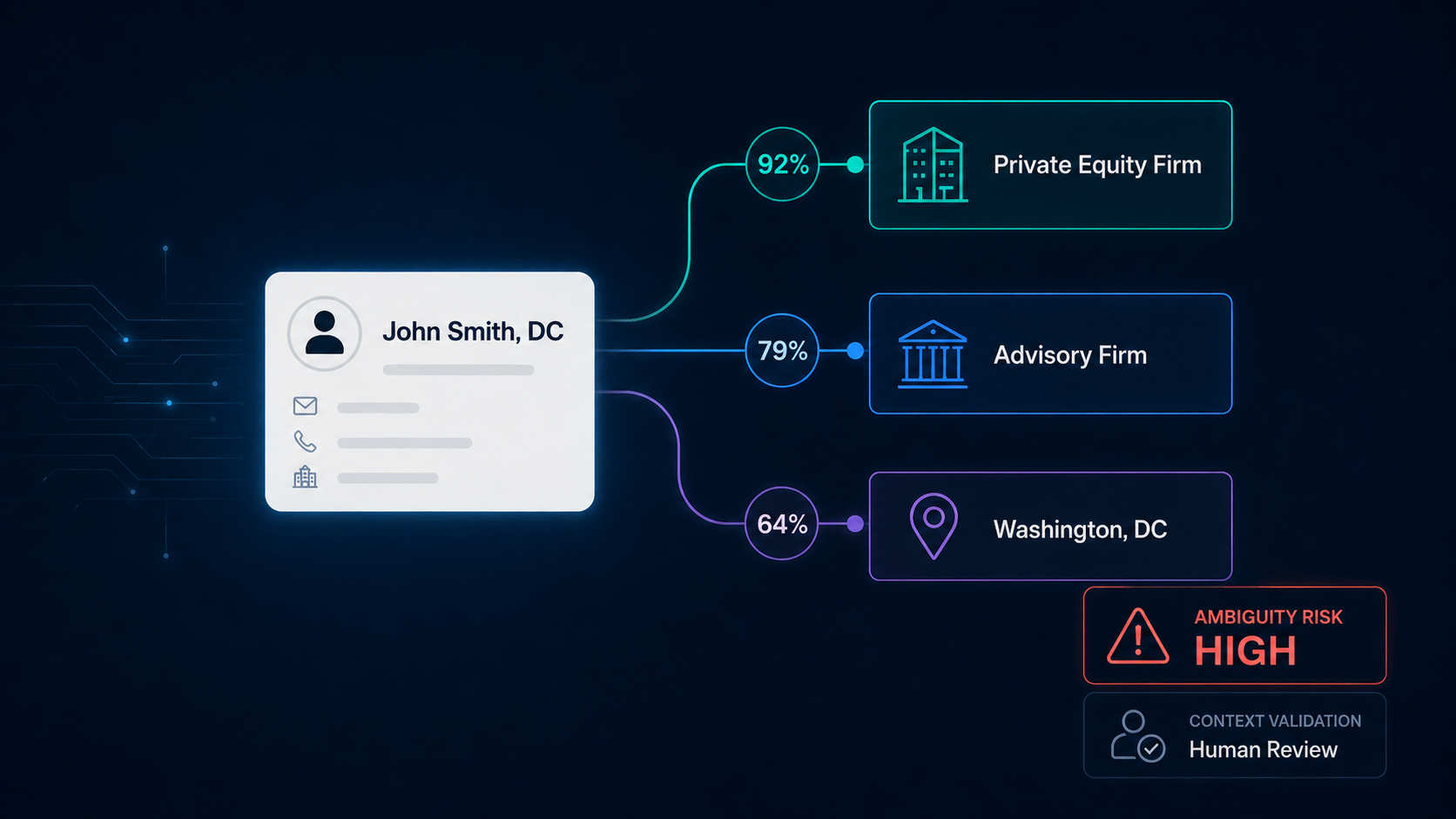
What if a private markets firm sent confidential deal information to the wrong person – not because of a software bug or a typo, but because an automated system misinterpreted a shorthand label and matched it to the wrong contact?
In institutional finance, errors like this can introduce regulatory exposure, damage relationships, and, in some cases, lead to direct financial loss.
There is a persistent belief that the hardest part of applying AI in institutional finance is choosing the right model. In practice, the bottleneck is usually the missing context layer that gives data meaning — and as AI adoption expands across deal pipelines, investor reporting, and compliance workflows, this gap is increasingly becoming a systemic risk rather than a technical inconvenience.
The illusion of “working” AI
Consider a scenario that frequently occurs in institutional finance workflows: updating a contact list after a conference or a series of meetings.
An AI system ingests a batch of unstructured contacts to evaluate, deduplicate, and merge into an existing CRM. Among them is an entry labeled simply: “John Smith, DC.”
Does “DC” refer to DC Capital, the private equity firm? DC Advisory, the UK investment bank? Washington, DC, as a geographic tag? Or something entirely unrelated, logged late at night under time pressure?
Without context, the system cannot know.
That ambiguity quickly turns into reality: the wrong contact merged, the wrong entity in a report, confidential information sent to the wrong person.
The model is functioning exactly as designed – the system is not.
Why automation alone breaks in institutional finance
The industry tends to frame AI in institutional finance as a problem of speed — faster workflows, less manual work, more automation. That framing misses the point. Technical correctness and real-world reliability are different thresholds, and most systems only meet the first.
AI doesn’t just inherit messy data — it amplifies it. And in private markets, that data is inherently inconsistent, shaped by how people record information under time pressure.
In some cases, models perform well. A global entity like “Blackstone Group” can be reliably resolved across variations because the model has strong external training signals.
But replace that with a mid-market or regional player — an entity with limited public footprint — and the system begins to fail silently. Variations like “LocalName Advisory,” “LocalN Advisory,” and “LocalName Adv” may or may not be treated as the same entity. The model lacks the context to decide.
And more importantly, it lacks the business logic to know whether they should be treated as one.
The complexity of institutional data
The problem goes far beyond naming inconsistencies. Institutional finance data may look structured, but in reality it is built from fragments — descriptions of firms, deals, and relationships scattered across systems and notes.
On paper, everything sits in fields and identifiers. In practice, those fields carry meaning that is incomplete and context-dependent.
Even technically strong systems fail when they process data without understanding what it actually represents. Here, data carries structure: how entities relate to each other — GP, LP, portfolio company — how those structures layer across jurisdictions and strategies, and how the same actor can appear in different roles depending on context. Without that, even clean data produces the wrong outcomes.
This knowledge must be designed, encoded, and maintained as part of the system architecture.
Where language models fall short
Large language models are powerful, but in institutional finance their limits show up quickly — they don’t know what they don’t know.
I’ve seen how this fails in practice: the same term can carry different meanings depending on context, and the model will still produce an answer that looks convincing but leads to the wrong outcome. The problem is not that the model is inaccurate — it’s that it has no way to recognize when it’s operating outside the right context.
On top of that, most of this data cannot be processed externally due to confidentiality constraints, which means even local models run into the same issue. Semantic similarity might look right in a vector space, but in financial systems, similarity without context is exactly how mistakes are made.
The compliance constraint
In institutional finance, errors escalate into regulatory events. When a system cannot explain how a decision was made, that decision cannot be defended.
Every output needs a clear, traceable logic path that stands up under scrutiny. A probabilistic match in a high-dimensional vector space does not meet that bar — it introduces risk at the point where accountability matters most. And in practice, explainability does not come from the model — it comes from the structured context layer that governs it.
What to do about it
The fix is not a better model. It’s a validation layer that sits between the model’s output and the point where that output becomes a decision. In practice, this comes down to three habits.
Separate proposal from decision. Let the model do what it’s good at: proposing that “John Smith, DC” and three existing contacts are possible matches. Don’t let it do what it’s bad at: deciding, on its own, which one is correct. That decision needs a second layer — deterministic rules, lookup tables of known entities, or a human — before it’s written back into the system of record.
Make confidence explicit. A match with strong external signal (a mega-fund like Blackstone) and a match with almost none (a regional player with no public footprint) should never be treated the same way by the pipeline. The systems that hold up are the ones that route low-confidence matches to a human reviewer automatically, rather than letting a single global confidence threshold wave everything through.
Feed resolutions back into the system. Every time a “John Smith, DC” case gets resolved manually, that resolution should become a rule, a lookup entry, or a flag for the next associate logging a similar contact. Otherwise, the same ambiguity gets solved by hand, at cost, every single time it recurs.
Without that, automation doesn’t just move faster — it fails faster, and in institutional finance, that cost shows up immediately. The real question for most teams isn’t which model to use next — it’s which of their automated decisions currently have no human checkpoint at all, and which of those they’d regret most if it were silently wrong.
Outputs can look correct — I’ve seen how often that creates a false sense of confidence. In institutional finance, that illusion is expensive, because mistakes don’t come from obvious failures, they come from decisions that seemed right at the time.
In this environment, understanding the data defines how the system behaves — and once you see that, it becomes clear why so many AI projects fail in exactly the same way.