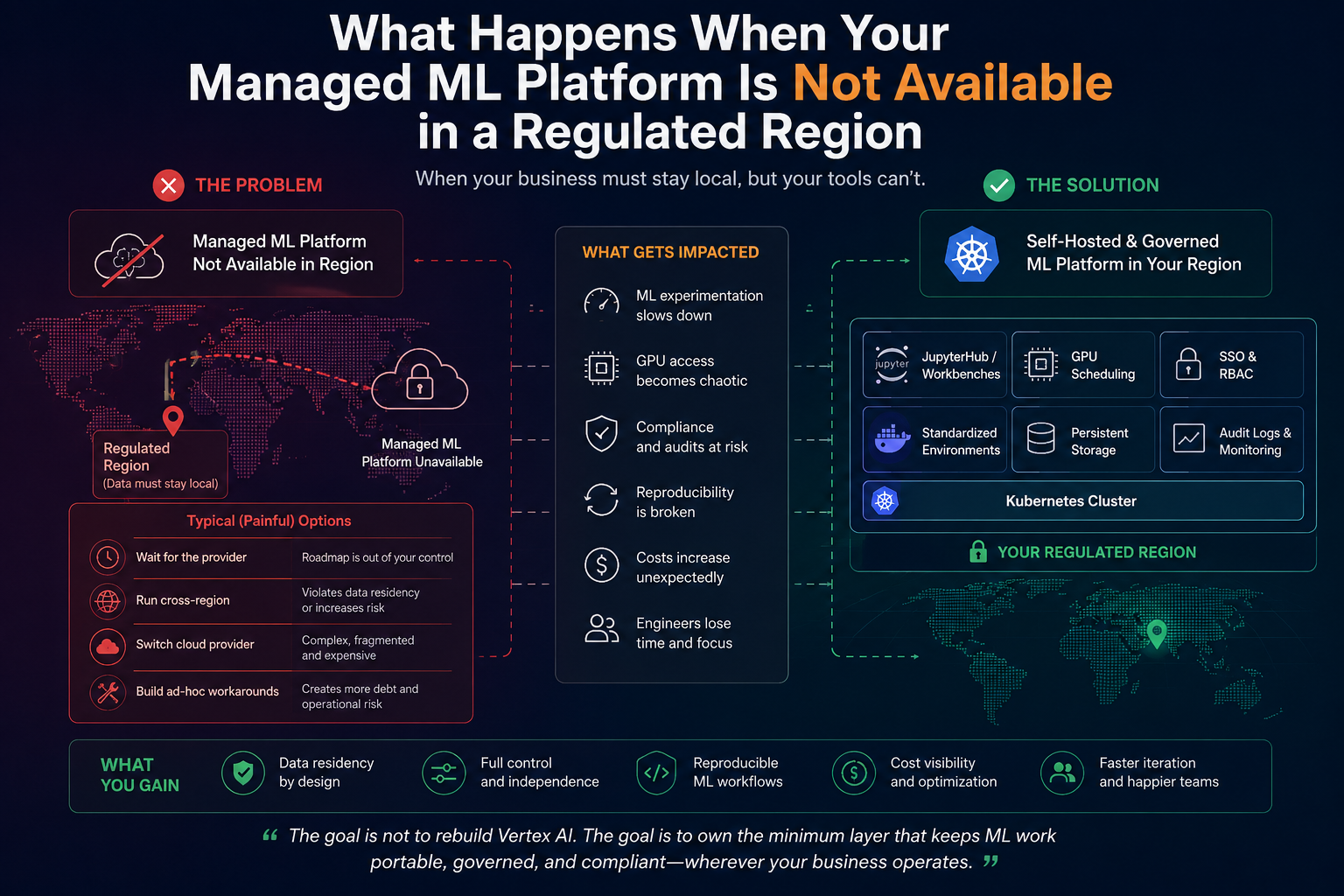
The hidden architectural risk behind managed ML services — and why teams need a fallback strategy before compliance, GPUs, and experimentation collide.
Managed ML platforms are attractive for a good reason. They give data scientists and ML engineers a fast way to run notebooks, attach GPUs, manage environments, and move experiments from idea to execution without waiting for infrastructure teams to provision every detail manually.
At the beginning, that is exactly what a growing company needs. The team moves faster. Experiments are easier to launch. GPU access is hidden behind a clean interface. Nobody wants to rebuild what the cloud provider already sells.
Then the business enters a regulated region.
Suddenly, the question is no longer “which tool is convenient?” The question becomes: can our ML workflows run where the law, regulator, customer contract, or internal policy requires them to run?
Sometimes the answer is no. The managed ML platform that worked well in the original region simply is not available in the region where the company must process data. That is when a tooling decision becomes an architectural dependency.
Managed ML works until the region changes
Many teams treat managed ML workbenches as productivity tools, not as strategic infrastructure. This is understandable. A notebook service looks like an interface, not a dependency surface. It is easy to think of it as “just where experiments run.”
But for ML teams, the workbench often becomes the execution layer for critical workflows: feature exploration, risk model development, recommender experiments, semantic search evaluation, fraud analysis, credit scoring, batch inference prototypes, GPU-heavy training runs, and debugging of production issues.
If that execution layer disappears in a regulated region, the impact is not limited to notebooks. The company loses a path for experimentation, iteration, and operational support. In regulated fintech, health, insurance, government, and enterprise AI, this can become a business problem quickly.
A managed ML platform is not just a tool. It is an architectural dependency.
What actually breaks
When a managed ML platform is unavailable in the required region, several layers are hit at once.
· Experimentation velocity drops because users lose their standard environment.
· GPU access becomes unclear or manual.
· Runtime environments drift as teams create their own workarounds.
· Access control becomes harder to audit.
· Data residency may be violated if teams continue running cross-region experiments.
· Reproducibility suffers because environments are no longer standardized.
· Cost control weakens because GPU usage is provisioned outside a governed workflow.
· Operational ownership becomes ambiguous: is this a data science issue, a platform issue, or a compliance issue?
The dangerous part is that every workaround can look reasonable in isolation. One team runs a job in the old region “just this once.” Another creates a custom VM. Someone exports a sample dataset. Another team moves to a different cloud. The business keeps moving, but the platform becomes harder to reason about.
That is how regulated ML platforms accumulate hidden risk.
The four bad options
When teams discover that their managed ML tooling is unavailable in the compliant region, they usually consider four options. Each can be defensible in a meeting. Each creates a different long-term problem.
1. Wait for the provider
This is the cleanest option if the provider roadmap aligns with business timing. It often does not. Cloud providers do not guarantee feature parity across regions on the schedule your regulator expects.
Waiting also turns platform strategy into dependency management. The company’s ML roadmap becomes blocked by another company’s regional rollout.
2. Run cross-region workloads
This is the fastest workaround and often the most dangerous one. If sensitive data must be processed locally, moving compute elsewhere may violate the spirit or letter of the requirement. Even if only derived data leaves the region, the boundary becomes harder to explain and audit.
3. Introduce a second cloud provider
A second cloud can solve regional availability, but it also fragments identity, networking, observability, CI/CD, cost management, security controls, and operational knowledge. The team trades one dependency for a distributed platform problem.
4. Build temporary scripts and manual environments
This is common because it feels pragmatic. A few VMs, some startup scripts, shared images, and manual GPU allocation can keep experiments alive for a while. But temporary ML infrastructure has a habit of becoming permanent just when the company is scaling.
The easiest workaround is often the one that creates the most expensive architecture later.
The real issue: dependency on a region-bound abstraction
The structural problem is not that a specific managed platform is missing. The structural problem is that the ML workflow depends on a region-bound abstraction that the company cannot reproduce.
If users can run experiments only inside one vendor service, with one identity model, one runtime model, one GPU access model, and one regional availability pattern, then the company does not fully own its ML execution layer.
That may be acceptable when the company operates in one market with low regulatory pressure. It becomes fragile when the company expands across jurisdictions.
A portable ML platform should make the managed service replaceable. It should define the minimum internal layer required to keep experimentation governed, reproducible, and compliant even when a provider service is unavailable.
What a self-controlled ML execution layer needs
The answer is not to rebuild an entire cloud product. Most companies do not need that. They need to own the narrow but critical layer that allows ML work to run safely in the required region.
|
Requirement |
Why it matters |
|---|---|
|
Region-local execution |
Experiments and GPU workloads must run where data is allowed to be processed. |
|
SSO and RBAC |
Access must be controlled, reviewable, and auditable. |
|
User and workload isolation |
Multi-user experimentation cannot rely on shared credentials or shared state. |
|
GPU scheduling and quotas |
Expensive resources need allocation rules, limits, and visibility. |
|
Standardized runtime images |
Experiments must be reproducible across users and environments. |
|
Persistent storage policy |
User work and artifacts need controlled retention and region-local placement. |
|
Audit logs |
Regulated environments require traceability of access and execution. |
|
CI/CD-managed configuration |
The platform must be reproducible, reviewable, and deployable from code. |
|
Monitoring and cost visibility |
The team must see workload health, utilization, and waste. |
A Kubernetes-based workbench layer, for example, can provide this without pretending to be a full managed ML product. JupyterHub or an equivalent internal workbench can be integrated with SSO, RBAC, namespaces, approved images, GPU node pools, quotas, and audit logs. The result is not a prettier notebook UI. The result is controlled ML execution.
Self-hosted does not mean unmanaged
The phrase “self-hosted” often sounds like a step backward: manual servers, snowflake environments, weak security, and endless maintenance. That is not the model.
Self-hosted badly means users create machines manually, share credentials, install random libraries, and run notebooks that nobody can reproduce. Self-hosted properly means the platform team defines the environment, access model, runtime images, resource limits, and audit trail as code.
In regulated ML, a self-hosted platform should be more governed than the managed service it replaces.
That is the standard. If the internal platform gives users freedom without guardrails, it will recreate the same fragility in a different form. If it provides controlled self-service, it can preserve experimentation velocity while satisfying regional constraints.
Cost savings are useful. Independence is the real outcome
There is often a financial argument for replacing managed ML tooling. Managed services can add a premium on top of raw compute costs, and GPU workloads are already expensive. As usage grows, that premium becomes visible.
But cost should not be the only argument. A cheaper unmanaged setup is not a win if it creates security gaps, lost experiments, inconsistent environments, or compliance uncertainty.
The more important outcome is strategic independence. The company gains the ability to run ML workflows in the regions where it operates, with its own access model, runtime standards, and resource governance. It can keep experimenting without waiting for provider parity. It can migrate without rewriting every workflow. It can explain its architecture to security and compliance teams without relying on hidden assumptions.
Cost savings are useful. Platform control is the real value.
When teams should start planning an escape hatch
A fallback strategy should exist before the managed platform becomes a blocker. Teams should start planning when they see any of these signals:
· The company is entering markets with data residency or sector-specific regulation.
· ML workflows depend heavily on managed notebooks or provider-specific experiment tools.
· GPU usage is growing and allocation is becoming political or manual.
· Runtime environments differ across teams and are hard to reproduce.
· Security asks for stronger auditability of model development workflows.
· Provider region availability differs across markets in the company roadmap.
· Cross-region data movement is becoming harder to justify.
· The team cannot explain how to recreate the ML execution layer from code.
These signals do not mean the company must abandon managed ML immediately. They mean the dependency should be made explicit, measured, and given an exit path.
A practical migration mindset
The best transition is not a panic rebuild. It is a controlled separation of concerns.
First, define what the managed platform is actually doing: authentication, notebooks, GPU allocation, images, storage, logging, scheduling, collaboration, and access control. Second, decide which of those capabilities are critical and which are merely convenient. Third, design the minimum internal platform that preserves the critical capabilities in the required region.
This prevents overengineering. The goal is not to copy every feature of the cloud provider. The goal is to own the small set of platform primitives that keep ML work portable, governed, and compliant.
Conclusion
Managed ML platforms are excellent accelerators. They help teams move quickly before infrastructure becomes a constraint. But in regulated, multi-region environments, they cannot be the only way the company knows how to do ML.
If compliance forces the business into a region and the managed ML platform cannot follow, the experimentation layer becomes a business risk. The company then has to choose between waiting, fragmenting, violating boundaries, or building under pressure.
Mature teams avoid that position. They use managed services where they fit, but they design an escape hatch for the workflows that must remain portable. They treat ML execution as platform infrastructure, not as a convenience feature.
The goal is not to rebuild a cloud provider. The goal is to own enough of the execution layer that regulation, regional availability, and vendor roadmaps do not decide whether ML work can continue.