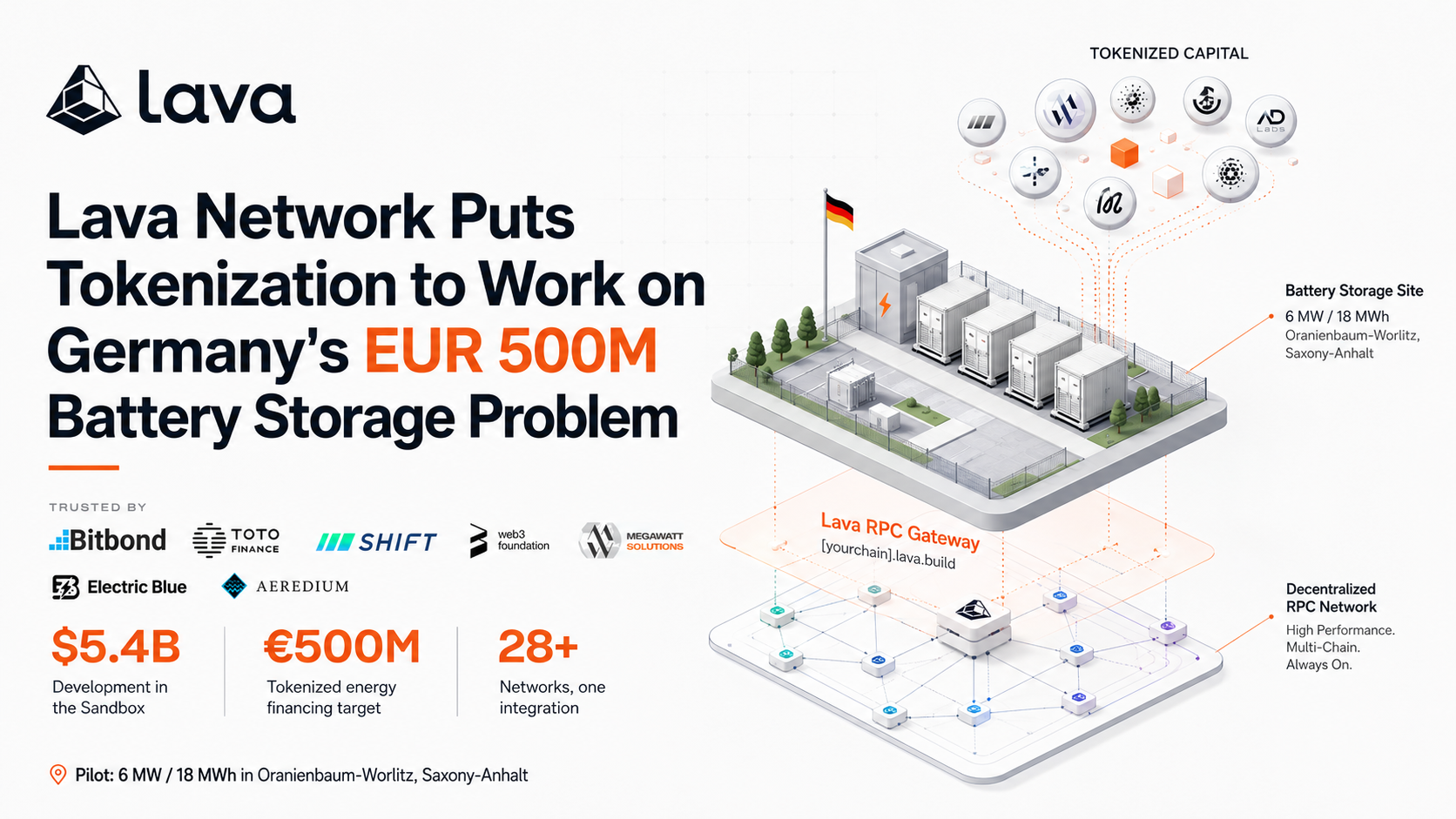
Germany needs to roughly quintuple its battery storage by 2030, and the capital to build it has to come from somewhere.

Lava Network is now testing whether tokenized financing can be part of the answer. The protocol’s Tokenization Sandbox has entered live deployment, with Berlin-based energy company Electric Blue running its evaluation of up to 500 million euros in tokenized battery storage financing on Lava’s decentralized RPC and API infrastructure.

Six weeks separate this from the Sandbox’s June launch, but the distance is structural, not chronological. The program has moved from a queue of institutional applications to an operating environment with real hardware, real interconnection timelines, and a real revenue model underneath the token layer. The first asset makes that concrete: a 6 MW / 18 MWh battery in Oranienbaum-Worlitz, in the eastern German state of Saxony-Anhalt, expected to reach commercial operation in late 2026 or early 2027. From there, Electric Blue’s program targets approximately 580 MW and around 1,750 MWh, a 97x expansion from the pilot.

The Grid Math That Makes This Deal Legible

Tokenized energy financing only matters if the underlying asset class is scarce, and in Germany it is. According to Fraunhofer ISE, the country operates approximately 29.8 GWh of battery storage today, while the institute’s scenario modeling puts the 2030 requirement between 100 and 170 GWh. That is a 3.4x to 5.7x buildout in under four years, in a market where renewable generation keeps outrunning the grid’s ability to absorb it.
The stress is already showing up in prices. In 2025, Germany recorded 573 hours of negative wholesale electricity prices, up from 459 hours the year before, while more than 2,700 GWh of solar generation was curtailed. Every negative-price hour is an arbitrage opportunity for a battery, and every curtailed gigawatt-hour is revenue the system paid to destroy. Storage operators capture that spread. The question has never been whether German batteries pencil out. It has been how to finance the buildout fast enough, and that is the gap Electric Blue is testing tokenization against.

From 6 MW to 580 MW

The Oranienbaum-Worlitz project is small by design. A 6 MW / 18 MWh system is a proving ground: large enough to generate real market revenue from arbitrage and grid services, small enough that the tokenization mechanics, investor reporting, and settlement flows can be validated before capital scales. If the structure holds, the program’s full target of roughly 580 MW and 1,750 MWh would place Electric Blue among the more ambitious independent storage developers in the country, funded through an instrument that traditional project finance desks are only beginning to price.

What Lava contributes is deliberately unglamorous. The protocol is not a tokenization platform and does not issue the assets. It provides the decentralized RPC and API layer that lets applications interact with blockchain networks on production-grade connectivity. For an institution evaluating whether tokenized financing can carry a half-billion-euro infrastructure program, the infrastructure question is not theoretical: settlement reliability, uptime, and independence from single centralized providers are exactly the variables the Sandbox exists to let participants test before committing.
The Pipeline Behind the Pilot
Electric Blue is the live deployment, but the Sandbox’s intake tells the broader story. Since the program’s announcements on June 10 and June 25, Lava has attracted more than 40 institutional applications across asset classes. The largest initiative in the cohort remains the previously announced collaboration with BHL, which is evaluating blockchain infrastructure for Alba Bay, a planned $5.4 billion master-planned development in the Dominican Republic led by Israeli entrepreneur Yossi Abadi. The project spans approximately 40 million square meters and around 40,000 planned residential units, making it one of the largest real estate initiatives anywhere currently exploring tokenization infrastructure.

The inaugural cohort rounds out across five verticals: Bitbond, APPLAYER, and AEREDIUM on payments and settlement infrastructure; SHIFT, an Israel-based platform exploring tokenized bonds and equities; and Toto Finance, a global platform tokenizing physical commodities including gold, silver, copper, and diamonds. More than 40 additional organizations are under assessment for future participation.

The composition matters more than the count. Real estate, energy, payments, securities, and commodities are five different regulatory regimes, five different settlement cadences, and five different investor bases, all evaluating the same infrastructure layer. If tokenization consolidates around shared connectivity rather than vertical-specific platforms, that is the structural bet Lava is positioned to collect on.
What to Watch
Oranienbaum-Worlitz commercial operation. The pilot’s target window is late 2026 to early 2027. Hitting it on schedule, with tokenized financing flows functioning through commissioning, is the single most important proof point for the entire program. A slip pushes the EUR 500 million target into a harder conversation.
Conversion rate on the 40+ applications. Intake is cheap; deployment is not. The ratio of applications that become live Sandbox deployments over the next two quarters will show whether institutional interest in RWA tokenization is pipeline or press release.
German regulatory posture on tokenized energy financing. BaFin’s treatment of tokenized infrastructure instruments, and the broader 2026 regulatory agenda for grid-scale storage in Germany, will determine how quickly a EUR 500 million program can actually be placed with investors.
Alba Bay’s next milestone. A $5.4 billion development moves slowly by design. Any concrete step from evaluation toward implementation on the Dominican Republic project would be the largest single validation of Lava’s institutional thesis to date.
Don’t forget to like and share the story!
Vested Interest Disclosure: HackerNoon has reviewed the report for quality, but the claims herein belong to the author. All market data is independently sourced and hyperlinked. Do your own research. #DYOR.